As promised, here is a video starring an exquisite ebony Russian Spindle from the Spanish Peacock. The motions are almost identical to those used with Tibetan spindles, but Russian spindles tend to be a bit wobbly until you pack some fiber on them. If you are having trouble starting up with your Russian, wind on some waste yarn until the spindle feels stable.
Showing posts with label spindles. Show all posts
Showing posts with label spindles. Show all posts
Thursday, September 16, 2010
Spinning for Lace Part Two: Russian Spindles

Tuesday, September 15, 2009
Current Knitting (and Spinning)
King Bat Shawl
I slogged my way to the finish line of the shawl body a few days ago. As you might imagine, I am very tired of pink. I have miles of edging to knit on before the thing is completed, but I am putting it aside for a while to let my Pink Receptors recover from extended stimulation. Cindersall's reversal of the crown motif was masterful, and I think it looks better than the original.
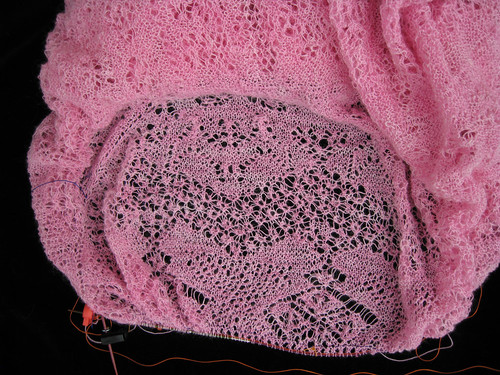
Honeysuckle Shawl/Sweater
Having carefully placed the Bat shawl on the bottom of my UFO pile, I decided to treat myself with my rendition of the Honeysuckle shawl/sweater thing, which appeared in Issue #6 of The Knitter.
This design is beautiful--elegant, graceful, and feminine. I had to read the directions four times because I simply couldn't believe that the designer would actually take a round shawl and convert it to flat knitting. Thus, the reader is instructed to knit across the pattern row, turn, purl back, and then, when the piece is finished, sew up the back seam. Nah. I am knitting it in the round like a grown-up.
For the sleeves, the original design calls for casting off 40 stitches one one row and then casting on 40 stitches in the next row. The sleeves are knitted separately and then sewn into the gap. Why make an ugly seamline at the shoulder and force the knitter to do even more sewing? Instead, I will knit a contrasting piece of yarn over 40 stitches. When I am ready to do the sleeve, I will carefully undo the contrasting yarn, pick up the stitches around the armhole, and knit the sleeves from the top down to the wrist.
In an incredible display of foresight, I decided to bead only the sleeves and the front side of the sweater. I realized that if I beaded the entire thing, I would wear the sweater once, wonder why my back felt like llittle glass beads were digging into it, slap my forehead, and put the thing away forever.
I am using Hamanaka mohair/silk Parfait yarn and some pretty beads that have been languishing in the closet for a while. Harry finds the piece rather restful. Too restful. I have to shake him out of the thing every time I want to work on it.

Spinning
I love Corgi Hill batts. I love them to pieces. I want to make an entire room out of Corgi Hill batts and live there. While I am busy accumulating the raw materials for the Corgi Hill Extension, I actually spun some up. Here's a neat ball of Navajo-plied merino/silk:

It will probably become a scarf for Kyoko-san if Harry doesn't filch it and bury it in his stash drawer.
And here's what's currently on the spindle:
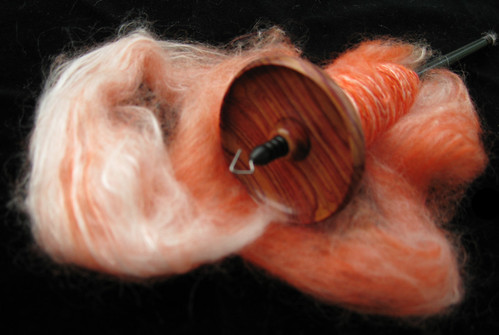
The lovely fluff is Corgi Hill merino/silk and the tulipwood/ebony spindle is from Spindlewoods. I have no idea what I will do with the finished yarn, but I am thinking it should be two-ply laceweight, which of course leads to wandering around my notebooks looking for an appropriate project. Like I need another project...
Saturday, August 1, 2009
A Rare Perfection
Spindles are much like sock yarn--there's always another one you have to try (at least for sock knitters) Other knitters might crave the next Noro colorway, brushed cashmere yarn, or the newest knitting needles fashioned from string beans. And non-knitters might yearn to acquire the complete works of Phillip Parker. As he has written over 200,000 books, that particular passion is even more profoundly time-consuming than spindle acquisition.
Anyway, having caught the spindle bug, I set out to test-drive spindles from a variety of craftspeople. I firmly believe that every quality spindle has a sweet spot in terms of fiber and yarn thickness. Some of my spindles are still in the drawer, awaiting their perfect mate. But of the eight spindles I now own, two spindles stand out as the epitome of perfection.
They are exquisitely made, perfectly balanced, beautiful to look at from all angles, and simply wonderful to use for a variety of different fibers.And I shall tell you about them another time.
Just kidding.
These two stunning beauties are from Spindlewood. The left whorl is camphorwood (smells spicy!), and the right whorl is bloodwood. They both weigh about 18 grams. Now take a look at the lovely workmanship on the shafts.
The camphorwood is now Number One in my Spindle Hall of Fame. Because of the perfect weight ratio between the shaft and the whorl, it feels much lighter than 18 grams and spins gossamer weight with grace.
Customer service is perfection too. During the creation process, Connie emailed me pictures of the whorls, then pictures of the shafts. When I asked for a darker shaft wood for the camphorwood, they graciously made me another spindle. And the spindle comes with a cover for the hook--a clever little touch.
And Then There Is The Golding...
The front of this spindle has a sweet and charming face made from a Russian brooch I found on eBay.
I eagerly opened the package to find a 22-gram black walnut whorl and a walnut shaft. Hmm. As soon as the yarn comes off the spindle, I will dye it black with a juicy permanent marker. This little fix was recommended on several woodworking sites. I tried it on another spindle--the ink is permanent and even shows the grain.
It must be me, because the whorl so overbalances the unadorned shaft that the spindle wobbles like a drunken Klingon (and spins about as well). It works perfectly fine for plying, however, so I didn't return it (Tom will give you a refund if you aren't happy). I am sure there will be some fiber in the future that will happily spin on this spindle, but for now, it remains a disappointment.


Subscribe to:
Posts (Atom)
