Tuesday, March 2, 2010

Three Lovely Shawls

None of which are actually on my needles, because I am literally knee-deep in The Queen Susan. Having finished the center, I can testify to the fact that it going to be huge. A rough-block of the center measures about 40x40 inches--almost large enough to be a shawl in it's own right without the border and edging.


When I get tired of plowing through the border rows, I have three shawls in my queue competing fiercely for Right of First Cast-On.

Luiza


Designed by Jane A. (Mawelucky on Ravelry), this masterpiece is the Harry wants to knit first, if only because of the magnificent colors (matches his belly button rings, I was told). The original, shown here, was knitted with fingering-weight yarn, but the pattern is open-ended and can be made with any weight yarn by increasing the number of repeats or doubling a finer-weight yarn. You can buy the pattern on Ravelry, or get it free with my very own kit in my Etsy store. The kit yarn is a Zephyr-weight called Firebird (2/20 60% merino, 20%  cashmere, 20% silk),--a lustrous, soft, luxurious yarn custom-spun for me. The default kit is Black Plum and Black, but any main color, for example, Lapis) may be ordered instead.

The Persian Princess


This exquisite shawl was designed by Bad Cat specifically for Love Potion #3. The design is intricate and made even lovelier by the addition of sparkly beads and a feathery border. The pattern is free if you purchase a skein of LP3; otherwise, you can buy the pattern directly from the Ravelry store.


Faroesertuch mit Blättern und Blüten 

(Photo by uta953)

The name means "Faroese shawl with Leaves and Buds," which doesn't do justice to this breathtaking beauty designed by Utlinde. The original was knit with sport-weight mohair on size 7 needles, so it should be a fairly quick piece to do. Alas, I do not stock any such yarn in my store, but I do have some stash that would work beautifully for this--a ball of Lisa Souza's mohair in the Mother of Pearl colorway flashes to the front of my brain. The pattern is, believe it or not, free from the Ravelry store.


Monday, February 8, 2010

Current Knitting and Spinning

I tried. Honestly,  I tried. For a week now, I've been skittering around the floor holding a sign that read: Attention fleegle! It't time for a blog post! Unfortunately, fleegle merely smiled absently in acknowledgement, and then wandered away to do who knows what. Well, this morning, I really lost my cool. Well, a little bit of my cool, because I am too cool to lose all my cool, as you all well know.

Enlisting the aid of a few friends, we attached fleegle's laptop to a crane, levered it over the bed where she slothfully lay sleeping, and mostly carefully lowered it onto her person. I regret to say that, after the cable slippage, fleegle did wake up and pay attention, but the Raid attack was not exactly the result we were looking for.


So, I, Harry, will write the blog post instead.

First, I have here fleegle's Owl sweater. Very soft and warm. And actually pretty well knitted for a human. I have her knitting notebook right here, so let me flip through the pages and see what she made this thing out of.

......riffle riffle, fwip fwip....

Hmm.
Ah, here we go.

Onions
Tomatoes
Raid
Kleenex
Pork chops
..................

Whoops. Grocery list.

Ah, found it!

Size 5/7 needles, white Yubina Bulky cashmere knitted with one strand of Colinette Paresienne in the Marble colorway. Simple bottom-up seamless yoke sweater pattern made with Knitware. Owl cables from an old Mary Thomas book. Pearl beads from somewhere. Time: 6 days.


Piled on top of the owl sweater were several skeins of handspun. Rather nice handspun. In fact, the yellow merino yarn makes an excellent mattress for yours truly. Not much in terms of notes, I'm afraid. The orange is merino/silk from Corgi Hill, the yellow merino is from Funky Fiber, and the lovely black merino/angelina sparkly stuff is from Bohemia Fibers. All these were spindle-spun, but there is no indication which spindles she used. Sloppy record keeping.


And lastly, I dragged fleegle's Queen Susan out of the tacky plastic bag and spread it out the best I could. So far, it looks like she's half done with the center and, to my surprise, there is not a single coffee stain on the entire thing.


Had I been knitting it, I am sure it would have looked better, but this, after all, is about fleegle's knitting, so I am trying to be nice. It is not easy after spending two hours in the shower to remove lingering Raid fumes.

Friday, January 29, 2010

Bart & Francis Open House

Sigh. I wish I could be there. But there is a Big Pond between me and this exotic yarn extravaganza, which will take place in beautiful Belgium, January 30 and 31st, from 9:30 am-6:30 pm.

For those who don't know about Bart & Francis, go here and sigh with envy. The store carries a wide range of exquisite yarns--lace and otherwise--some of which are simply not available anywhere else. Their silk yarns make me weep a bit, and they stock exotica such as mirror and glass bead yarns, vicuna yarns, and linen and stainless steel thread.

If you can make it to the open house, you will be able to play with their fabulous offerings and I will hate you. The owners will handle your questions and assist those with special textile-related requirements to find exactly what you are looking for.

Francis assures me that all this will be done is a cozy atmosphere, featuring a never-before-encountered "Dump Your Husband Corner," stocked with a broad range of fancy alcoholic beverages and newspapers to keep him accupied while you, the textile lover, can range freely over their offerings. Of course, you can tenderly park your wife or SO there instead, and the brochures below indicate that tea and pastries are  also being offered.

And here is the announcement in a variety of languages :) Yarnlot, do enjoy your trip and post about it, because I am sure you won't want to miss this affair.


Bart & Francis
OverleieStraat  59
8500  Kortrijk
België
info@bart-francis.be


Monday, January 18, 2010

No-Purl Garter Stitch In-The-Round

Problem
When knitting a Shetland shawl, the center square is knitted back and forth in garter stitch. Then the border stitches are picked up around two sides of the square, thus producing the first row of a circular border. However, if you want to maintain garter stitch on the border, every other row needs to be purled. There's nothing intrinsically wrong with purling (there are even some knitters who prefer it), but for most people, purling can quickly get tiresome when the border has 1000+ stitches on each round.

Pseudo-Solutions
The alternative to purling every other round is to turn the work somewhere, somehow, and knit back, essentially knitting the border flat and using some hocus-pocus to bind the two border edges together. All of the solutions rely on a fancy wrap-and-turn on one corner...making a loose yarnover and knitting it with the next stitch; picking up the bump on one edge and knitting it with the last stitch of the row; sewing the seam when the border is completed, and so on. None of these solutions pleased me. I could always spot the turn line from a galloping horse. No good.

Fleegle's Solution

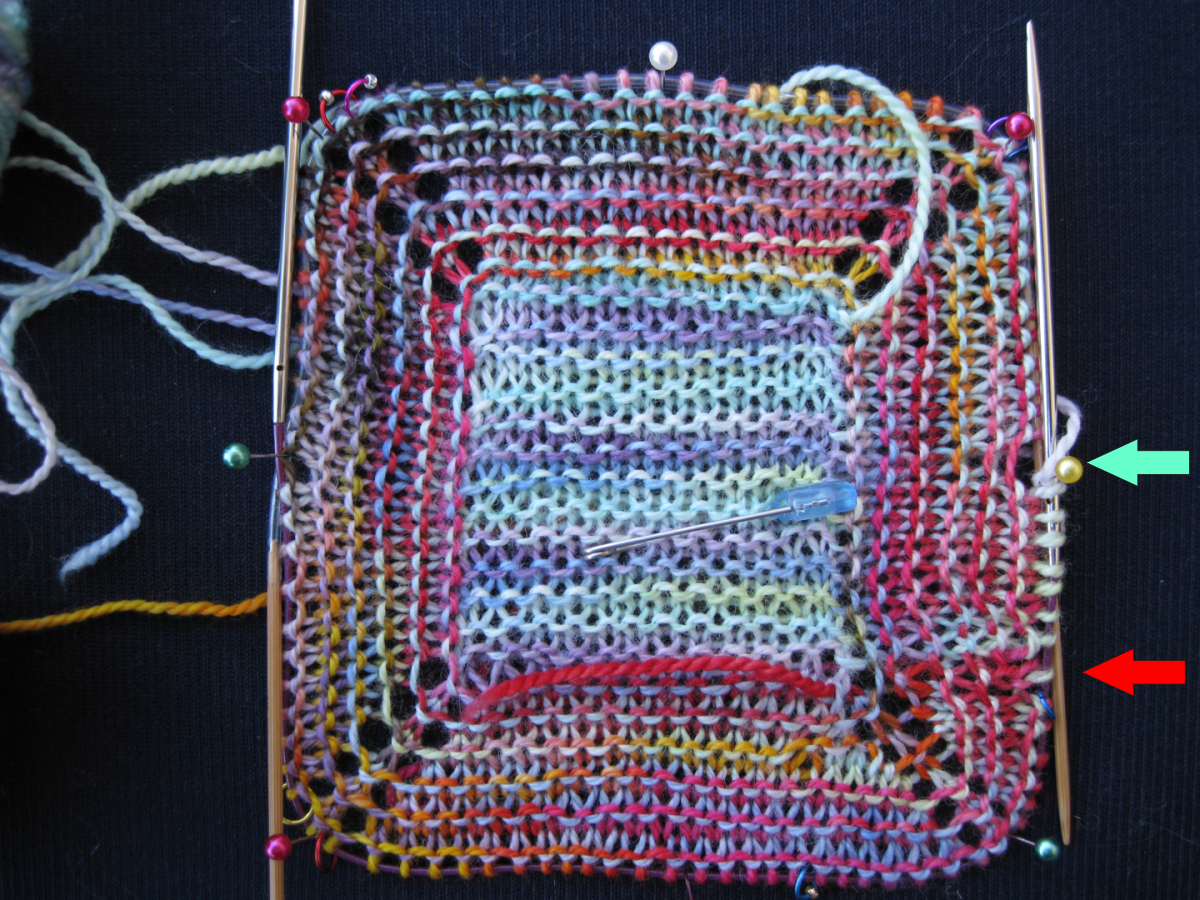
This humble-looking sample  represents a solution to a dilemma that has plagued knitters since the first dinosaur broke two limbs off a tree, wound some vines into a ball, and produced the world's first Stegosaurus shawl.


In the sample shown above, the border is knitted flat, not circularly, but there's no discernible seam, is there? The red arrow points to what you might think is the seam, but it's actually the place where the next row begins. Circular knitting, as you recall, isn't really a circle--it's a spiral.


The solution turns (bad pun, sorry) out to be relatively simple: knit the border using two balls of yarn, not one, alternating direction, so that one ball of yarn (A) is knitted in one direction, the other ball (B) in the other direction. The aqua arrow above shows the position of the yarns in the current row and the place where the switch will happen. The trick that makes this solution work is that A and B are going in different directions, there’s no turn at all, and thus no wonky seam line.

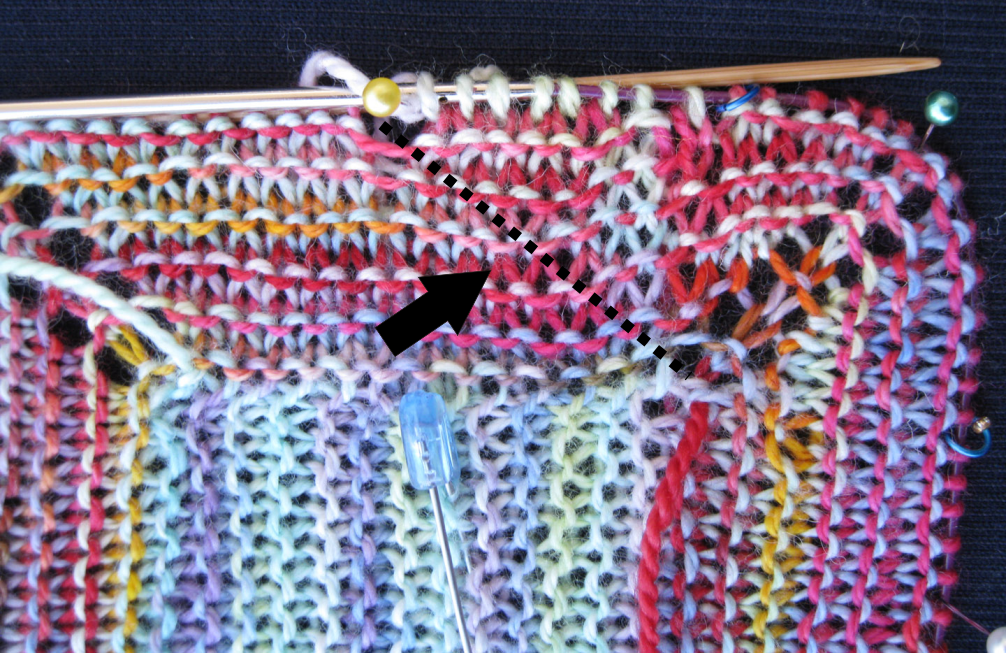
In the image below, the actual color/yarn change for the rows is shown along the dotted black line. Note that the yarn travels one stitch outwards with every other row because of the yarnover increases at the corners. I did a sample where I cheated one stitch and kept the change point in the same place with each row. It didn't make any difference--there still was no seam line.


Here are the directions for a little sample, so you can try this yourself. I used sock yarn scraps in two colors and cast on 13 provisional stitches because I am incredibly lazy and 14 stitches was just too much work. It's a small sample, so when you do the border, you'll need one additional circ or a set of DPNs to go round and round.

Knit a center square with Color A.

Pick (do not pick up and knit) up the stitches along the first side, slip the stitches from the provisional cast-on, then pick up the stitches from the third side, slip the last group of stitches. Don't forget to pick up a stitch at each corner.

Note: At this point, I strongly suggest you rearrange your stitches so that the corners fall towards the centers of your needles, not at the ends. Otherwise, you will be working yarnovers at the ends of your needles, and that's always messy.

You are now at the beginning corner.

Attach color B, turn your work, and knit all the way around to the beginning corner.

Drop B, turn, pick up A, and knit around, working an OKO at each corner.

Drop A, turn, pick up B and knit plain around.

And so on.

In this sample, you will always be doing OKO at the corners with color A and a plain knit row with color B.

I put a safety pin on the side where I should be knitting color A, so I didn’t get confused. Obviously, when you are knitting a real shawl, both balls will probably be the same color. I will therefore put a safety pin on one side of the shawl and a some indicator on the corresponding yarn ball when I use this technique on my Queen Susan shawl.

And, of course, this trick is not limited to shawls--it can be used any time you want to knit garter stitch in the round without purling.

Thursday, January 7, 2010

Rana Pilosus

January 7, 2010
Dateline Kyzyl-Oi, Kyrgyzstan

Scientists today announced the discovery of the fabled Rana Pilosus, the Hairy Frog of knitterly legend! Hitherto mentioned only in passing on a multitude of knitting blogs ( as in "The yarn looked like frog hair, so I ran away screaming."), this endearing amphibian is no longer a myth, but a reality. In fact, Rana Pilosus cultivation turns out to be a major economic industry in a remote area of Kyrgyzstan.

Dr. Elmer Vrkyng and his graduate student, Bob "Hoppy" Hopper, semi-distinguished amphibian zoologists at the University of Uch-Korgon, made their tremendous discovery while floundering around in marshland north of town. Dr. Vrkyng explained that they had overindulged in fermented mare's milk (not much to do in Uch-Korgon besides drink and flounder) and decided to take a walk and clear their heads. Unfortunately, they wandered into the infamous Gryznyk Swamp and got, um, bogged down.

"Bob fell flat on his face, causing a torrential tidal wave that floomed all over my clean shirt. When the water, mud, and algae subsided, I felt a tickling sensation on my forehead. I reached up and discovered a webbed foot caught in my pith helmet. I tugged frantically on the squishy offending limb and was suddenly face-to-face with a genuine Rana Pilosus! His other leg was curled around my earlobe! I immediately whipped out my camera and took a picture of this monumental discovery."


Dr. Vrkynk and Mr. Hopper subsequently interviewed the nearby townspeople, most of whom were  oddly dressed in layers of delicate knitwear. Apparently, the surrounding area, being mostly swamp, was not conducive to raising sheep, yak, or vorpal bunnies. However, the town was overrun with furry frogs, especially during the Annual Festival of Flies, an occasion marked by fly-calling, fly-swatting competitions, fly markets, and highly decorated swatter sales.


Over the millenia, frog herding became the town's major source of income. The only other business in Kyzyl-Oi is a vowel importer, and apparently the import tax on A's and E's is so outrageous that the company only accepts a few shipments of I's and O's every year and thus doesn't offer much hope of employment. Mr. Krygzy, who owns the company, says Vrknuk's Vowels has spent a ton of grybzyfs in search of a new vowel, but have not had much luck so far.

In light of the poor job market, frog herding has become the sustaining business. According to Madame Grizkyrg, who owns the largest frog spread in the area, the Rana Pilosus is an economical crop, as the frogs take good care of their families, are excellent padkeepers, and require only an occasional rinse with conditioning shampoo to keep snarls and split ends under control. And, she adds, the frog industry is unquestionably Green!


Madame Grizkyrg explains. "Our frogs are free-range, happily playing cards and engaging in frog-wrestling tournaments by day, and indulging in karacroake at night. In June, the frog shearers armed with tiny scissors, lure the frogs (with homemade fly snacks) onto supersized pads, where they are carefully shorn of their pelts." She went on to say that the hair is then washed, sorted, and spun by the locals to produce extremely fine yarn, which is then knitted into garments during the severe winter months. As you can see from the picture, a shorn frog is a happy frog!


"One gram of frog hair, spun in our little factory, will produce over 5000 meters of yarn. And the frogs come in a wide range of colors and patterns, including polka dot and herringbone, so we don't have to worry about dyeing it," says Madame Grizkyrg.


She went on to say that the frogs make excellent pets, as they are clean and very intelligent. There are two frog trainers in town who coach the ambhibians in Kyrgyz, the native language, as well as instruct them in the rules of  Frog Paddy Bingo, a subject that will not be further discussed in this article. A new niche business has recently emerged, thanks a sizable grant from the TSA.  Azrygyr is one of several being trained as drug- and explosive-sniffing frogs.


The TSA will soon be deploying these little guys in both the personal security and baggage-screening areas. Being small, they can easily hop around inside carry-on and checked baggage. When contraband is detected, their hair stands straight up and vibrates silently, quietly alerting the agents. The frogs' foot-long tongues have been genetically modified to carry an electrical current and, on command from the TSA Frog Handlers, will zap offenders, who are then dropped through a trap door directly into a paddy wagon.

Dr. Vrkyng and Mr. Hopper will be staying in the town for three months studying this new genus before publishing their findings in Nature. After they have completed their research, they intend to start an eco-friendly frog-hair yarn exporting business. "Our enterprise should bring a business boom to Kyzyl-Oi," says Dr. Vrkyng.

All of us lace knitters look forward to seeing the product! Right? Don't we?

Monday, December 21, 2009

End of the Year Miscellany

I have no monumental news or projects to report, but there are a few items to post about, not the least of which is that Harry has sold his karaoke machine and taken up meditation. When asked about this dramatic about-face, he said he was preparing to knit The Queen Susan Shawl, which is now available here.This is a temporary link, but the pattern should be available in the Ravelry store by the time you read this. The pattern But please come back and finish reading this last post of 2009.

I hope you will download the 73-page pattern even if you don't intend to knit it immediately (or ever). Those who think they could never attempt such a masterpiece will benefit from studying the pages and working the suggested swatches. You might discover that this shawl, as daunting as it appears, is still knit one stitch at a time--and the stitches themselves are not complicated.

Next, I want to address a few reader requests. I have received numerous messages, both here and on Ravelry, requesting information about how I spin such fine and even lace yarns. Given the avalanche of spinning books that have been published in the last few years, plus the enormous wealth of videos on YouTube, I decided to ask my readers: Do you want a lace spinning tutorial, and if so, do you want videos too? I don't have a video camera, so I would have to borrow one, but if there is enough demand, I will work out the logistics.

The second reader request has been around for years--that I write a book. Only one person has ever detailed what she thought such a work should actually contain, but she did have some excellent suggestions. So the question I ask here is, do you really want a book from me, and if so, what do you want it to cover? And how much of the book can be blog material? Few people read my old posts, and there is a wealth of material there that I would like to include. Asking me to write a book is an effective form of flattery, but I really need more information about subject matter that would be useful, informative, entertaining, and not already beaten into tiny knitting molecules elsewhere.

Please understand that I am not a designer, and have no intention of writing a book of patterns. But if there are enough subject requests, I will turn my attention to completing such a work in 2010 or shortly thereafter. Now is the time to speak up if there are knitting and/or spinning topics you want me to address.


And so, I bid Good Riddance to 2009, and wish all of us a lovely 2010--a new decade and fresh start.

Sunday, December 13, 2009

Current Knitting (and Spinning)

The Queen Susan shawl seriously impinged on my knitting and spinning time over the last few months. Fortunately, the pattern booklet is now off my desk and onto that of Laura, a most wonderful copy editor. I am hoping she will have time this week to work her magic, so I can upload the pattern shortly thereafter. I promise to announce availability when it's off everyone's desk and into the Ravelry pattern database.

Despite Queen Susan, I managed to complete a few small items for Christmas gifts.

I made two hats, one of which I cannot post about, because Kyoko-san is not allowed to open her present before December 25 and I don't want to spoil the surprise. However, the hat I made for Jun is not under any secrecy doctrine.


Jun's family owns Rhubarb, one of the few non-Japanese eateries in Togane City, Japan--the Nepalese chicken curry is especially good. We love Rhubarb's desserts: the lemon pound cake is particularly delicious.

I am sure you guys remember the Friendship Cake Plague? Every few weeks someone would drop in bearing a wad of Friendship cake starter. The idea was that you used to it make your own cake batter, reserving a blob to foist on someone else. We actually made one cake from the stuff and pronounced it Worse Than Grandma Tillie's Matzoh Balls, and frankly, I didn't think anything--foodstuff or otherwise--could earn that distinction.
 
After five of these batter bits had been charmingly received  and surreptitiously handed off to the increasingly resentful neighborhood wildlife, we escaped to Japan, a country renowned for green tea and sashimi, but not for Americanisms such as Friendship cake.

So of course, the first thing we spotted, to our horror, in Rhubarb's dessert case a few days after arrival was--wait for it--Friendship cake. Clearly, a batter glob had somehow stowed away on a jetliner and slithered from Narita to Togane.

Regardless of this lamentable gastronomical lapse, Jun remains a good friend and deserves a warm hat. I used two skeins of Noro Silk Garden, removing the weird green yarn in the middle of the skeins, reserving it for future knitted frog toys. The little 2x2 cable pattern was spontaneous and I took no notes.


Tonya's son is now old enough to appreciate the fact that his older sister has something he doesn't, so I now knit them pseudo-matching gifts. This year, Nina receives Douglas, The Extremely Happy Giraffe, while Kai gets Horatio, The Happy Hippo. Both patterns are free, from Bobbie Padgett.


 Horatio is proportionately smaller than Douglas (to match the size of the children), but equally squashy and adorable:


As for spinning, well, there is a drawer full of singles waiting for an appropriate plying device. I hate, loathe, detest plying. It's boring. It's dull. It's frightful. But! There's a beautifully wrapped package sitting on our Gift Slab that may address the Plying Problem. In the meantime, the myriad little copps sit quietly, waiting for Plyness. But I am not idle.

The Spindlewoods pink ivory spindle in the top photo holds gloriously silky Suri alpaca from The Critter Ranch, and the spindle in the lower two images is clearly enjoying luxurious 50/50 silk/merino roving from The Fiber Denn. It might be the only smiling spindle ever made!


Saturday, November 28, 2009

The Queen Susan Shawl

Yeah, yeah. Harry has been following me around for the last few days, poking me with his swagger stick  to remind me that I haven't posted a blog entry in weeks. Because his swagger stitck is an exquisitely sharp quilting needle equipped with a customized leather handle, being poked with it gets the point across (Ouch! Bad Pun!).

Most of my time for the last few weeks has been sucked up into a fascinating collaborative project called The Queen Susan Shawl (based on a photograph by M. Sutherland, from The Shetland Museum  Photographic Archive). 
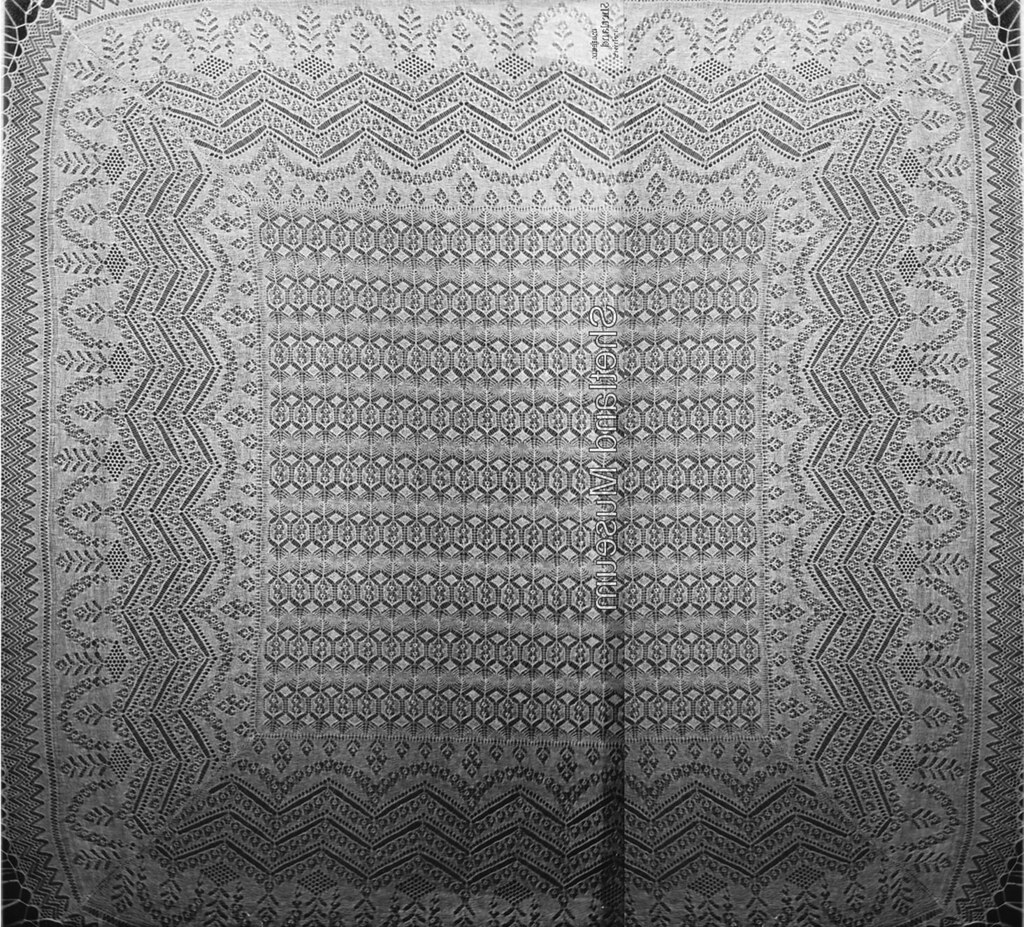


The project is remarkable in so many ways. It shows, first of all, the power of a social networking site such as Ravelry, to foster communication across the entire globe. The shawl is so lovely and so complicated, but by combining all of our skills, The Ravelry Heirloom Knitting Forum has re-created the pattern for this masterpiece. Right now, the only missing bits are the corner chart and a paragraph or two of  calculations. We are hoping that by the New Year, The Queen Susan shawl pattern will be available on Ravelry, free to anyone who wants to hoard, knit, or just cherish this delightful design.

Because I have been working like a little fiend on all aspects of the shawl, I am not going to recapitulate the history. Instead, I am posting, with my own permission (seeing as how I wrote it), the introduction to the pattern booklet. It's a lovely story, so please enjoy!


Little did Clarabeasty realize what a firestorm she would start when she innocently posted a shawl picture from the Shetland Museum on the usually quiet Heirloom Knitting Ravelry forum:

October 16, 2009
Clarabeasty: Does anyone recognize the border pattern on this piece of lace? Specifically the part that looks like little wreaths and twigs.

Sophiphi137: No, but it is beautiful! I also am now very curious about it.

M1K1: Look again in the Shetland Museum photo library. There is a close up detail of another shawl which has the scalloped (wreath) effect made by placing roses.
You can get a really good look at it by selecting Large Image.
Isn’t it a fabulous effect - softening the straight lines of the zigzags.
Actually this might be the same one you showed above...

fleegle: Wow! That’s the most beautiful border I’ve ever seen…..gets out graph paper immediately….

This innocent, offhand exchange would result in a mammoth project involving more than 30 people and hundreds of hours of charting, swatching, proofing, writing, editing, and layout.

We started off rather simply with the center design, which we recognized from other shawls. The pattern, called Spider Webs, Spiders, and Diamonds, was easy to chart from other sources. But then, Msleoknits, presented an alternative center that she had charted and used for another shawl. Her design eliminated the garter stitch interruption in the spider webs, and many of us preferred her design to the original one.

Similarly, Q-Knitter graphed the original edging. a variation of Mrs. Sutherland's Fine Lace, a coincidence that made us all smile with delight. EdithCone subsequently presented a second, more delicate pattern—a variation of Alpine Lace—and made a chart for it, as well.

Now we had charts for two centers and two edgings, and the project was not so simple anymore.

The border, clearly the charm point of the shawl, presented numerous problems. First of all, the original shawl was clearly knitted in the traditional manner. The center and borders were worked separately and sewn together. We all decided that we wanted to knit the piece in the modern way, that is, knitting the center, then picking up the border stitches and knitting the rest of the shawl in the round. And this method meant that we had to invert all the motifs in the border.

Piece by piece, each motif was charted and test-knitted. In many cases, we had to choose among several alternatives. After a few weeks of experimentation and decisions, we had a semblance of a genuine, workable border chart.

The corners presented more difficult decisions. While we liked the original corners, we wanted something special. KnitLab became our Guy in the Corner, working up the beautiful flower sprays that integrate so well with the main border area. In what can only be called an astounding feat of charting, M1K1 not only charted the complex corner, but turned part of it inside out so less-experienced knitters could better see how the pattern fit together.

When all the parts were finally defined, LarasCreations spent weeks developing the calculations. A few days after M1K1 and LarasCreations had mostly completed their assignments, fleegle jokingly suggested adding a row above the bottom row of flowers:

fleegle: Not terribly radical. Although you would have to regraph the entire corner.

fleegle climbs into her nuclear blast bomb shelter and closes the hatch. Click.

larascreations: Well…….it does seem like it might look nicer with another 1-2 between?
What’s one more line?
……runs to keep fleegle company

fleegle: …fleegle yells through the blast door, informing Lara the price of admission are the new calculations…

laceknitterlois: “NOOOOOOOOO”….flipper proofer runs & throws supercape over m1k1’s computer screen.

“Don’t look, m1k1!”
Points pointy finger accusingly at larascreations & fleegle:
“Sure, go ahead and give m1k1 heart palpitations. And where does that leave us? Without our Professor of Corner Chartology!”
Makes ultimate threat:
“Which means you 2 would be sentenced to take over corner charting duties. Knock it off, ya hear?”
Leaves scene whistling. Just keeping the world safe, one knitter at a time.

As you might expect, the concept of an additional row was tabled forever, amidst heartfelt apologies entailing considerable virtual groveling. Gentle humor and mild tangents that drifted into totally unrelated topics made all of us smile amidst our piles of graph paper.

In the meantime, we realized that we needed to think about how we were going to present the finished pattern, and we needed to bring the Shetland Museum into the loop.

The consensus was that the pattern should be placed into Creative Commons without copyright protection, and should be available as a free download on Ravelry, a highly popular site for knitters. But we wanted to alert the Shetland Museum to the work and give them the files, so visitors to their web site could download the pattern from there, as well. Perhaps the museum would be able to use the pattern as a donation magnet.

Here is the original letter written by edithcone to the Shetland Museum.

Novmber 6, 2009
Dear Ms. Christiansen,


    I’m writing to you on behalf of a group of knitters who were very inspired by one of the shawls in the Shetland Museum and Archives Photo Library. The shawl in question is found in the photos numbered S00019 and S00024.


    We are members of Ravelry, an online community of knitters and spinners from around the world. Within Ravelry, our group, Heirloom Knitting, is particularly interested in fine Shetland lace knitting. The shawl shown in the photos above, was brought to the attention of the group and the design was so well-liked it was proposed that a collaborative effort be made to create a chart of the original design and produce a pattern that could be downloaded free-of-charge from Ravelry. After much debate, the shawl was named The Queen Susan shawl.


    We would like to give mention to the Shetland Museum for housing the original photo which led to the project. We also thought you might be interested in being able to offer the pattern for download from the Shetland Museum site (thereby making it available to non-Ravelry members).


    Is it possible you have any background information about this shawl, such as the name of the knitter/designer, the approximate date it was made, the location, etc.? M. Sutherland is noted as the photographer. Was the shawl likely made by a member of his family? Any information you could give us about the shawl would be very helpful and appreciated.


    Because this is such a large project, it will be some time before any of us finish knitting an entire shawl. In light of this, we would be extremely grateful for the use of one of your photos (with credit given to the Shetland Museum), so that we can show a completed shawl in the pattern instructions.


    There has been a tremendous co-operative effort within the group and at this point, most of the elements of the shawl have been charted. There are few Shetland lace shawl patterns of this complexity available today and none, as far was we know, that have been produced by knitters from all over the globe. It is exciting to be involved in this project, one that we hope will make a beautiful Shetland shawl design available to knitters everywhere and help continue the tradition of Shetland lace knitting.


    I hope you will entertain our request to use one of the photos mentioned at the beginning of this letter. I look forward to your reply.
Yours Sincerely,
 Denise Furukawa

(on behalf of the HK Ravelry group)

And here is Dr. Carol Christiansen’s response:

November 13, 2009
Dear Denise,


Many thanks for your email. We were delighted and intrigued by how our photographic archive has been put to use once again.


The photographer M. Sutherland was Magnus Sutherland, of Colvadale, Unst. He was related to a number of expert lace spinners and knitters, some of whom are pictured in photograph R01400. He took the photographs of the lace pieces in the late 1890s or 1900 – one scarf has the date 1899 knitted into it and it is likely that the other lace pieces were photographed at the same time.
This shawl is not part of our collection. However, we have several other shawls and stoles knitted by the Sutherland women, one of which is on display. It has similar centre and border motifs to the one you are knitting. Our records indicate that the border of the shawl on display was designed by the brother of the Sutherland sisters, probably Magnus himself. It is possible, but by no means certain, that Magnus was involved in the design of the shawl you are knitting.


The Sutherlands designed and traded patterns with one another, as you can see from Magnus’ photographs that many of the shawls bear similar motifs but used in different combinations. If the designs were written down by the Sutherlands, which is unlikely, this information has not passed to us. However, the reason we have these early photographs of Magnus’ is that they were passed on to Ethel Henry, who donated them to the Museum. Ethel Henry was herself an expert knitter and knitwear designer, working in both Fair Isle patterning and some lace – she designed wonderfully stylish fine lace jumpers in the 1950s! We have two of Ethel’s lace notebooks, one in which lace patterns are written out, in another where they are charted. Some of the motifs found in the Sutherland laces are described in these notebooks. Unfortunately, Ethel stipulated that the notebooks not be published, and therefore, we can only offer them as study materials here in Shetland.


Have you completed the pattern for this complex shawl? If you are struggling with any parts of it, please let me know and I will see how I can help.


I will meet with our IT person next week to discuss sending you the Magnus Sutherland photograph for the completed pattern and how to attach Ravelry information/download to the photographic archive website. I shall get back to you with this information in due course.
Best wishes,
Carol

(Dr. Carol Christiansen, Shetland Museum and Archives)

Having received an enthusiastic response from the Shetland Museum, we continued the cycle of chart, knit, proof, write, edit, chart, proof for several months. Until finally, we had all the material at hand, and this pattern booklet could be assembled for what we hope is your visual and knitterly delight.

It was decided to name the shawl The Queen Susan, because several of the ringleaders bear that name or have close relatives who do. We also felt that the name conferred a certain dignity on this lovely piece.

And finally, although fleegle wrote the introduction, EdithCone pointed out that she barely mentioned her own contributions.  So, I will lapse into the first-person at this point and say that I was the initial instigator; graphed the original center and border; assigned the test knitting; wrote the bulk of the text; designed and laid out this pattern booklet; and generally pushed, poked, and prodded the participants where necessary to get the pattern assembled in a timely manner. I was the hub around which activity whirled, but without the other contributors, the project would never have come to fruition.

The Ravelry Heirloom Knitting Group now presents to you The Queen Susan Shetland Shawl, and hopes that you will derive as much pleasure in working it as we did in developing the pattern.

Shieladeedee’s post sums up the project thusly:

I’m feeling a little weepy here. Think of it - a piece knitted before the turn of the last century, designed by a close group of family/friends living in an isolated area, preserved in a photograph, being recreated by a far-flung band brought together by technology and a love of this craft.

Saturday, November 7, 2009

The Amazing (and Cheap) Spinning Notion--Zia!

I don't often write about tools, because there's really not much new under the sun. Let's face it, a knitting needle is a knitting needle, and everyone has an opinion about composition, pointiness, and configuration. But they are still knitting needles, you know?

However, no spindle spinner should be without a Zia. And wheel spinners might find her handy, as well. Let's take a little tour.

First of all, Zia holds your spinning projects. The units are stackable, and come in a variety of colors. I like the clear ones so I can easily see what's inside. If you don't want your project open to the air, just place everything in a plastic bag before dropping it into Zia. She's got a handle so you can tote her around.


You can use a Zia to hold your spindles, too--just turn it on its side. Put a piece of foam down on the bottom if you like. The foam will prevent your spindles from slipping through the bottom holes. I don't have any foam in this picture, but you get the idea.


You easily can store your copps in Zia. Mine are mounted on clear soda straws. And of course, you can use Zia for plying. Notice that in this picture, I ran straight knitting needles through a few straws (the only use I have for my Mother's Bernat straight needles). The silver handle is on the top side...


...If you flip the handle to the other side, it keeps the needles from sliding and also adds a bit of tension. If you need more tension, make sure the handle is on top of both the straw and the needle. You can slip a bit of eraser or non-slip pads through the points and snug them up to Zia's side to eliminate any unwanted slippage.


Best of all, Zia is not expensive!
\\

I bought mine at the Container Store, but they are also available on-line from Ace Hardware. Amazon, Organize, and many other suppliers. The one in the picture is the smallest size.  Go shopping!

Monday, November 2, 2009

It's a Sweater! It's a Shawl! It's Honeysuckle!

Although I love to knit shawls, I do not love to wear them. The sole exception is my tiny Hyrna, which slips neatly into my purse for A/C protection during the summer months. As for the rest of them, I take them out for show-and-tell when somebody asks. Otherwise, they sit around in a drawer, playing cards, drinking beer, and watching PBS's Knit and Crochet Today on an iPod Harry installed for them.

The Honeysuckle sweater immediately caught my eye, because it combines the best of all possible worlds. I could knit some simple lace with my favorite luxurious Hamanaka mohair/silk and have an actual, wearable knitting object.

This inspired pattern appears in Issue Six of the elegant British magazine, The Knitter, and was created by Sarah Hatton, Rowan's in-house designer.


Of course, I changed the pattern a bit. For starters, the original configuration is a circular shawl knitted flat and seamed. The sleeves also knitted flat and seamed, and then sewn into the bind-off/cast-on slits created for the armholes.

Well, all that sewing seemed ridiculous, tedious, and annoying. Instead, I knitted the shawl in the round, using a contrasting thread for afterthought armholes. I then picked up the sleeve stitches around the contrasting thread and used Barbara Walker's clever short-row sleeve cap method to knit the sleeves downward.


I also added beads to the sleeves and sweater front, and changed the boring edging to the more dynamic Ocean Wave from Miller's Heirloom Knitting. And, there was a lot of plain knitting in the original pattern; I dropped in a few Shetland cat's paws motifs to break up the monotony.


  The only mild setback was the cuff area. I have thin wrists, and even though I doubled the decreases at the end, the cuff was still too baggy for me. Instead of ripping out the mohair (urgh), I threaded some narrow ribbon through the final row and gathered the cuff.


Best of all, Honesuckle informs me that she detests beer, can't play cards, and doesn't enjoy TV, so leaving her out of the drawer and actually wearing her pleases everyone. Well, except for Harry, who is always looking for another sucker for his rigged poker games.

Monday, October 26, 2009

An FTC/Litigation/Copyright-Safe Book Review

A few posts back, I mentioned a test-knit that I was doing for a designer. I fearlessly quote my own blog post below, as I wrote it and gave myself written permission to quote it elsewhere under the Fair Use provision of copyright law. The excerpt is fewer than 50 words, so I should be doubly safe from self-litigation.

... a test knit so hideous that Laptop scuttles out of the room (hissing) whenever I remove the thing from its lightproof bag. To add insult to injury, the supplied yarn's texture rivals that of steel wool, but is not quite as soft.

Having placated the copyright cops, I state here, for the comfort of the FTC, that both the pattern and the yarn were given to me. However, neither were gifts, as I must return both the knitted object and the remaining yarn to the designer, for which I will be paid a pittance. I did, however, receive a free copy of the pattern, and this I shall gleefully burn. Aside from the appearance of the thing, which Harry and I agree is the single ugliest knitted work in the history of textiles, the pattern contains several errors. The designer did not respond to my queries, so I assume that the errors are now written in stone printer's ink.

It turns out that the pattern is from a book the designer has written, as I discovered on Saturday. I picked up a book at SAFF, and was smacked in the eye by The Ugly Object as I riffled through the pages. It occurred to me that I ought to do a book review, since I have an intimate acquaintance with at least one of the patterns contained therein.

I am not, however, going to mention either the book title or the author, lest I be sued for libel. Similarly, I will not be showing you any photographs or quoting content, for fear of breaking copyright law. I am safe from the FTC as well, because I neither bought, nor received the book as a gift, so do not now, nor have I ever, had it in my possession.

So, I present to you an FTC/Litigation/Copyright-Safe Book Review. Please feel free to reuse the words here for your own book review. As you will see, my coverage will work for just about any knitting book you dislike, while keeping you out of the courts and the prison system! Furthermore, I give everyone blanket permission to blatantly copy everything written below in perpetuity.

Fleegle's Hard-Hitting Review of                                                                  , by                                           , available from                                             , 2009.

The title of this book is very descriptive of the contents, but the designer's taste leaves something to be desired. I've never seen anything quite like these finished objects, which are actually not intrinsically ugly. However, the designer's choices of yarn and color transformed the plebeian patterns into a chaotic visual jumble.

The body text font is a very thin, condensed typeface, making it difficult to read and even more difficult to follow the directions. The color plates, paper, and binding are very attractive. Nice job, printers!

The book has a table of contents, an index, and a bunch of designs in between. I won't tell you how many there are, because you might figure out which book I am talking about and notify the designer. In turn, the designer would contact a lawyer and I would be sued for libel. Let's just say that there are more than five and fewer than 100.

I noted that most of the patterns could be found for free on Ravelry, and would most definitely benefit from your own personal and tasteful choice of color and yarn. I am not going to tell you what kinds of patterns we are talking about, because again, you might guess the book and I would be sued. The patterns are definitely all knitted, most with worsted weight yarn. Some patterns were knitted with other yarns, but I am not going to furnish any more details, except to say that you will need some knitting needles to complete them. A few stitch markers would be a good idea, too.

So, to conclude, unless you are a fan of visual hysteria, I discourage you from purchasing this book.

And with that, I leave you until next time, when I shall present photographs of an actual finished lacy sweater, knitted and photographed by me, and completed this very day.

Thursday, October 22, 2009

Mind Boggler of the Day

I rarely comment on news items, but these two blips are beyond ludicrous. The PRS is the British equivalent of the RIAA, who, we assume, will surely adopt these Draconian regulations in an effort to squeeze the last penny out of anyone dumb enough to hum in public.

PRS Threatens Woman For Playing Radio To Her Horses Without Paying A Licensing Fee

PRS's Latest Trick: Demanding Money From Shop Assistant Who Was Singing At Work

Friday, October 16, 2009

More Wickedness

A while back, I posted a pattern link to this lovely shawl (Something Wicked This Way Comes, by Karen Walker).


 Although I love the red, I know that I would be bored to tears knitting miles of it, and this shawl is BIG. And it seemed to me that Something Wicked needed Something Black...the most wicked of colors. I begin a thought process.......

......Time passes. Aliens come and go in the back yard. Harry assassinates karaoke from Albania to Zanzibar. The RIAA sends Al Jolsen a copyright infringement notice. The FDA issues a recall notice on water (too much water will cause people to explode and that's not acceptable). Blue Cross/Blue Shield announces that having been born is a now considered a pre-existing condition and will no longer cover any illness or injury for any claimant who has undergone this process........

.......I think about knitting the edging in black. Nah. Too abrupt. Then I think about dip-dying it. Nah. Too chancy. Then I think about spinning the yarn and new possibilities present themselves. I finally emailed Anna at Corgi Hill Farm, sent her a picture of the shawl, and explained what I was looking to do. She's brilliant, folks. She carefully dyed a graduated series of silk/merino batts for me that will, after I spin it all up, give me a nice flow from Wicked Red to Wicked Black.


I have about 7 ounces of batt, and need about 2200 yards of two-ply, which works out to 314x2=628 yards per ounce. And that, after consulting various tables, is about 80 WPI. Doable, but it's going to take some time.

So the only Wickedness you're going to see around here for a while is Harry. Apparently, he had a nice gig at the Two Tables Restaurant in Zanzibar City. Unfortunately, a two-table audience was way too small for his ego, so he's taken some time off to kayak the Zambesi river. The guides discovered on his first day that Harry's rendition of  Moon River caused crocodiles, algae, and hippos to flee from the river at Mach 2. The tour company is trying to sign him to a long-term contract. I personally wrote him a stellar letter of recommendation.

Tuesday, October 6, 2009

Terrible Tuesday

It has not been the best of days. The early morning hours were spent writing begging, whining eloquent, pursuasive letters to an assortment of accounting departments that owe me back pay.

Having completed this distasteful task, I moved on to the Project of the Day, namely a test knit so hideous that Laptop scuttles out of the room (hissing) whenever I remove the thing from its lightproof bag. To add insult to injury, the supplied yarn's texture rivals that of steel wool, but is not quite as soft.

I unpacked the magenta, yellow, orange, turquoise, and black yarns, donned my sunglasses and Kevlar gloves, and knit two rows (actually I knit one row and purled one row) of the convoluted, confusing directions painstakingly deciphered from the blurry scan of tightly packed, faint type.

Whoops. I am instructed to attach C, then knit some rows with D and F. Except why did I attach C? Removes sunglasses and gloves, emails the designer. Replaces project into lightproof bag and stuffs into closet.

Moving on to the Alternate Project of the Day, I unpacked the printer I was asked to review for a World Famous Techie Magazine. Too bad paper and ink cartridges were not supplied. Poked at the buttons for a few minutes and discovered that the printer has the unfortunate feature of Speech. Does anyone want a talking printer? After listening for a few minutes (Hi! My name is Phil and I'll be your printer today!), I resisted the urge to shoot the little elecronic creep in the USB port and began the Alternate Alternate Project of the Day.

Fortunately, this project actually went quite smoothly after the initial cast-ons, which featured long tails that were too short. I see from the pattern that I need 200 yards of yarn. I have 198 yards. What are the odds of having enough yarn for the last row?

Find out next time, because I am afraid to fire up the camera. It can talk to the printer.

Tuesday, September 15, 2009

Current Knitting (and Spinning)


 King Bat Shawl

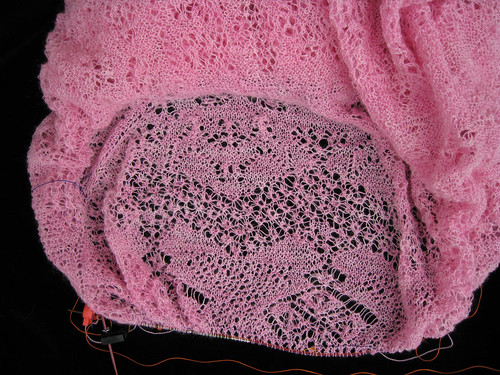
I slogged my way to the finish line of the shawl body a few days ago. As you might imagine, I am very tired of pink. I have miles of edging to knit on before the thing is completed, but I am putting it aside for a while to let my Pink Receptors recover from extended stimulation. Cindersall's reversal of the crown motif was masterful, and I think it looks better than the original.


Honeysuckle Shawl/Sweater
Having carefully placed the Bat shawl on the bottom of my UFO pile, I decided to treat myself with my rendition of the Honeysuckle shawl/sweater thing, which appeared in Issue #6 of The Knitter.

This design is beautiful--elegant, graceful, and feminine. I had to read the directions four times because I simply couldn't believe that the designer would actually take a round shawl and convert it to flat knitting. Thus, the reader is instructed to knit across the pattern row, turn, purl back, and then, when the piece is finished, sew up the back seam. Nah. I am knitting it in the round like a grown-up.

For the sleeves, the original design calls for casting off 40 stitches one one row and then casting on 40 stitches in the next row. The sleeves are knitted separately and then sewn into the gap. Why make an ugly seamline at the shoulder and force the knitter to do even more sewing? Instead, I will knit a contrasting piece of yarn over 40 stitches. When I am ready to do the sleeve, I will carefully undo the contrasting yarn, pick up the stitches around the armhole, and knit the sleeves from the top down to the wrist.

In an incredible display of foresight, I decided to bead only the sleeves and the front side of the sweater. I realized that if I beaded the entire thing, I would wear the sweater once, wonder why my back felt like llittle glass beads were digging into it, slap my forehead, and put the thing away forever.

I am using Hamanaka mohair/silk Parfait yarn and some pretty beads that have been languishing in the closet for a while. Harry finds the piece rather restful. Too restful. I have to shake him out of the thing every time I want to work on it.


Spinning
I love Corgi Hill batts. I love them to pieces. I want to make an entire room out of Corgi Hill batts and live there. While I am busy accumulating the raw materials for the Corgi Hill Extension, I actually spun some up. Here's a neat ball of Navajo-plied merino/silk:


It will probably become a scarf for Kyoko-san if Harry doesn't filch it and bury it in his stash drawer.

And here's what's currently on the spindle:

 
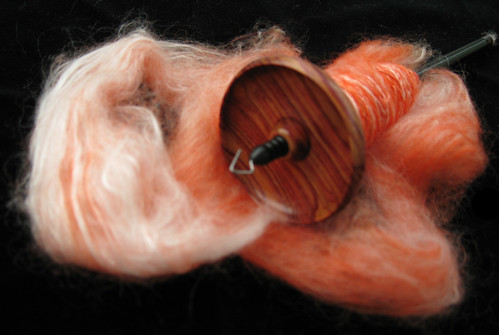
The lovely fluff is Corgi Hill merino/silk and the tulipwood/ebony spindle is from Spindlewoods. I have no idea what I will do with the finished yarn, but I am thinking it should be two-ply laceweight, which of course leads to wandering around my notebooks looking for an appropriate project.  Like I need another project...