Showing posts with label sweaters. Show all posts

Monday, November 2, 2009

It's a Sweater! It's a Shawl! It's Honeysuckle!

Although I love to knit shawls, I do not love to wear them. The sole exception is my tiny Hyrna, which slips neatly into my purse for A/C protection during the summer months. As for the rest of them, I take them out for show-and-tell when somebody asks. Otherwise, they sit around in a drawer, playing cards, drinking beer, and watching PBS's Knit and Crochet Today on an iPod Harry installed for them.

The Honeysuckle sweater immediately caught my eye, because it combines the best of all possible worlds. I could knit some simple lace with my favorite luxurious Hamanaka mohair/silk and have an actual, wearable knitting object.

This inspired pattern appears in Issue Six of the elegant British magazine, The Knitter, and was created by Sarah Hatton, Rowan's in-house designer.


Of course, I changed the pattern a bit. For starters, the original configuration is a circular shawl knitted flat and seamed. The sleeves also knitted flat and seamed, and then sewn into the bind-off/cast-on slits created for the armholes.

Well, all that sewing seemed ridiculous, tedious, and annoying. Instead, I knitted the shawl in the round, using a contrasting thread for afterthought armholes. I then picked up the sleeve stitches around the contrasting thread and used Barbara Walker's clever short-row sleeve cap method to knit the sleeves downward.


I also added beads to the sleeves and sweater front, and changed the boring edging to the more dynamic Ocean Wave from Miller's Heirloom Knitting. And, there was a lot of plain knitting in the original pattern; I dropped in a few Shetland cat's paws motifs to break up the monotony.


  The only mild setback was the cuff area. I have thin wrists, and even though I doubled the decreases at the end, the cuff was still too baggy for me. Instead of ripping out the mohair (urgh), I threaded some narrow ribbon through the final row and gathered the cuff.


Best of all, Honesuckle informs me that she detests beer, can't play cards, and doesn't enjoy TV, so leaving her out of the drawer and actually wearing her pleases everyone. Well, except for Harry, who is always looking for another sucker for his rigged poker games.

Thursday, March 26, 2009

Odds and Ends

A Cure for Knitting Ennui
A few days ago I was flipping through my pattern collection in search of Something Different. At last count, I've been knitting for 58 years (urk!), which means I am abysmally jaded. The old saying "What Goes Around Comes Around" certainly applies. The same sweaters/hats/scarves/dishcloths/tippets have gone around and come around so often that I can point to a picture and recall at least five previous incarnations.

I was grazing through this season's knitting magazine offerings and for the first time I can remember, I bought neither Interweave Knits nor Vogue Knitting. The offerings in the former were tired and the projects in the latter made me laugh.

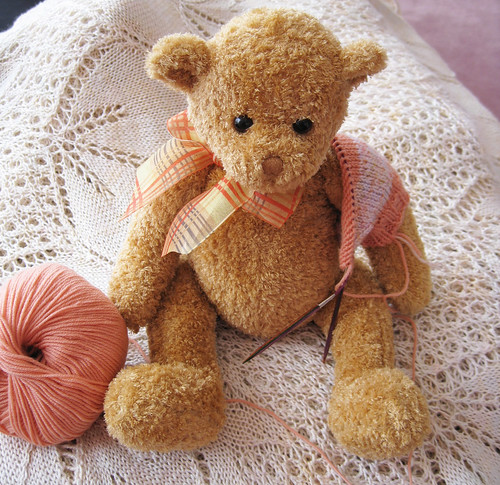
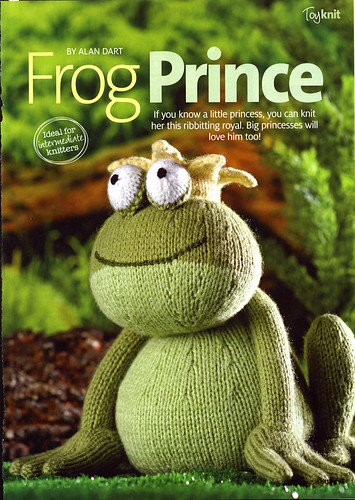
Fortunately, I have a dear friend in England (Thanks, Jo!) who faithfully traipses to her news agent every month and ships me a lovely package of Across-the-Pond knitting magazines. Although Simply Knitting is for the beginner/intermediate knitter, every issue carries an Alan Dart toy pattern, and I dearly love these. I couldn't resist this one:


It went right to the head of the queue. The yarn is sitting in front of me waiting for me to finish this blog post.

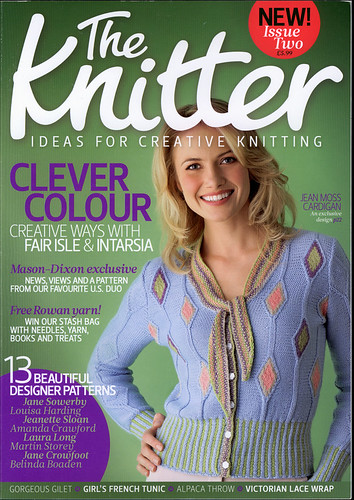
Some brilliant English publishers thoroughly perused American knitting magazines and decided that they could do it better. And they certainly did! My last two care packages included an issue of a brand-new offering entitled The Knitter.


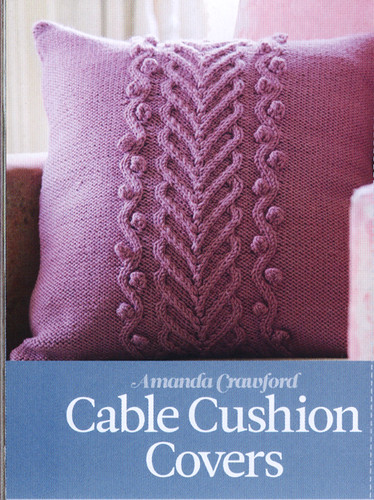
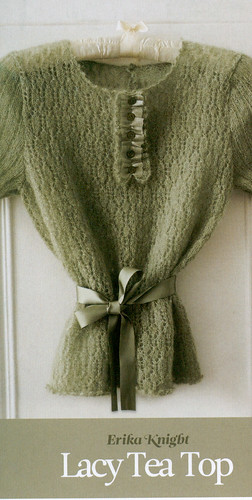
A few sample photos:


Intended for the experienced and adventurous, the two first glossy issues have been inspiring and beautifully laid out--treasures of knitterly eye candy. The only problem with it is that the magazine is not yet available in the US. I hope the publishers will consider overseas distribution, because advanced knitters here will surely snap up every issue. It's apparently available at bookstores and yarn shops in the US and Australia, so go get a copy!

Pattern Obscura
There's a wonderful thread on Ravelry entitled Favorite Obscure Patterns--I cruise through it often (Warning! Big Time Sucker!). Thanks to the diligence of the posters, I've added an embarrassment of items to my queue. The Internet also offers zillions of patterns that never seem to rise to public acclaim, and I want to tweet my kazoo about two of my recent favorites.

The first one is a lace shawl called Something Wicked Comes This Way, designed by Karen Walker. It's stunning! It's unusual! You can purchase it here. Go ahead--you know you want to!


--Photo Courtesy of No Two Snowflakes/Karen Walker (Thanks!)

The second pattern comes from the famous White Lies Designs. However, I haven't seen anyone get excited about this pattern...
....but I think it's eyepopping. And I have sufficient Yubina worsted-weight cashmere to make it. I have asked Harry dye the yarn for me in the requisite luscious shade of crimson, and he's agreed to do it in exchange for our new car and a year's supply of chocolate-covered beetles. A fair trade for him.

Yarn Obscura
Artist's Palette Yarn is one of my favorite Internet stores. Yes yes, she's in England. but the postage isn't punishing and the yarn will make you weep with delight. I've purchased a variety of her offerings--the quality is superb and the dying exquisite. Do give her store a try if you are looking for a little treat. Here are a few of her many types of yarns.

Glisten is a luxurious 2-ply 100% silk yarn, soft as down. I actually bought all four skeins--1200 yards will make a lovely shawl. Sorry, folks.


Damsel is 80% Extra Fine Merino 20% Silk cobweb weight, with 1200 yards per skein. She's currently having a 20% off sale. Don't you hate it when I tell you things like this?


And finally, I want to also report that I have also fallen in love with the yarns from No Two Snowflakes. Her stock isn't extensive and goes quickly, so you'll have to regularly troll her Etsy shop and see what's available. I snagged a skein of Roses and Lilacs cobweb-weight silk:


...and two skeins of Juicy Nectarine cobweb weight 50% silk, 50% wool.


Have fun grazing!

Thursday, February 28, 2008

A Normality Sweater

I love inventing ways to do things--the invention process is often so much more intriguing than actually knitting the object. Once I've worked out the principle, I find myself wishing for an apprentice who could just follow my notes so I don't actually have to knit the darn thing.

Alas, I have no apprentice (applications are being taken now!), so after figuring out how to work this sweet little sweater, I had to produce a finished object, otherwise nobody could figure out what I was babbling about.

What?
In this post, I will demonstrate the principles of sideways seamless construction, which can be applied to all sorts of useful and non-useful things--toys, hats, doorknob covers, whatever. Pithy directions follow all the picture stuff.

Why?
Sideways construction has several things to recommend it.

First of all, most people look, um, not so wonderful in horizontal stripes. But knitting a regulation sweater with vertical stripes is about as fun-filled as, say,sleeping on golf balls. Each stripe requires a different ball of yarn just waiting to tangle up with all the other balls of yarn dangling from the needle. If you forget to twist, you get a hole. Face it, you don't see a lot of striped intarsia sweaters. But knitting a vertically striped sweater sideways requires only that you change yarn color after each stripe. And you can decide on-the-fly just how wide you want the stripes to be.

Second, some types of yarn are inherently droopy--cotton and silk for example. Sideways construction can alleviate the tendency of these fibers to stretch and sag.

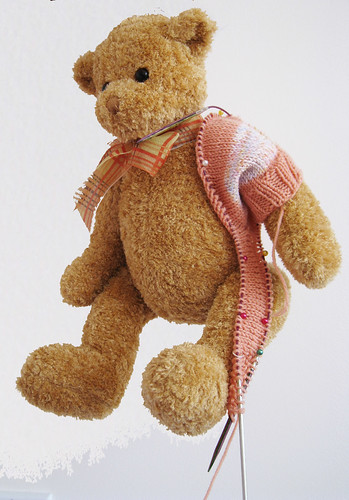
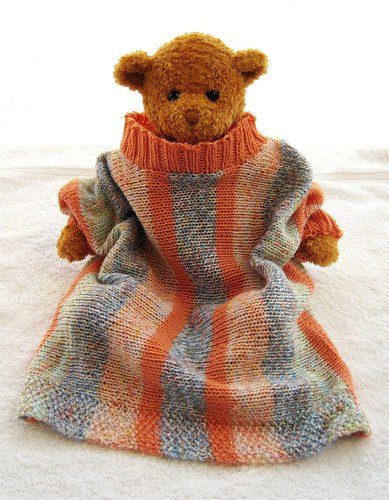
Thirdly, you can easily try on the sweater as you go along, as demonstrated by Larry in the accompanying picture essay.

And lastly, it's just fun to do things at a 90-degree angle. All sorts of interesting problems present themselves to be solved with incredible cleverness or brute force, depending on your attitude and and/or Clever Quotient.

So, onwards to the lesson.

How?
Here we have a perfectly normal little sleeve knitted in the round on two circular needles. Anyone who has knitted a tube will know how to do this. (If you don't, the Internet is full of information about this technique.) From this tiny acorn, we shall make a sweater grow.


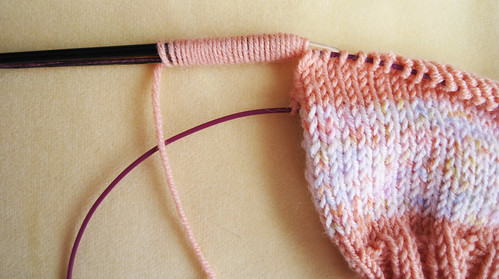
First, we cast on the stitches for the front and back using my beloved Turkish cast-on. This fancy and exotic name just means: Wrap the yarn around two needles--couldn't be simpler.


The yarn is at the bottom front of the sweater, so I turn the needles over so the knit (right side) of the garment is facing me and knit back. I am putting a moss stitch band at the bottom edge. Alternatively, you could knit the entire garment plain and pick up the stitches later for a ribbed bottom edge.

You have to be a bit careful here to pick up the correct needle to knit back. If you do it wrong, you'll find you will get up to the sleeve and suddenly, the purl size is facing you. Whoops--better start over.

The sleeve stitches are now shoulder stitches.

As I cruise over the shoulder, a lovely sight greets my eye, namely, all the back stitches just waiting for me to knit up.


And so I do. Now I am at the lower edge of the sweater back.


I turn, and purl back to the front again.


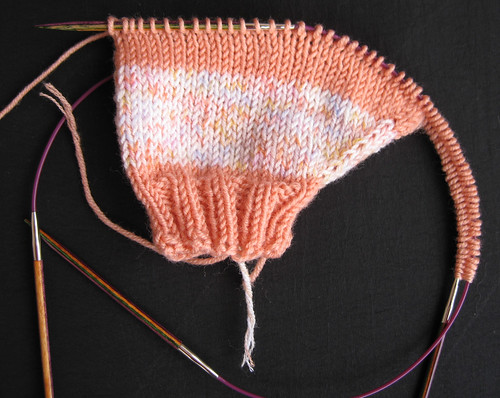
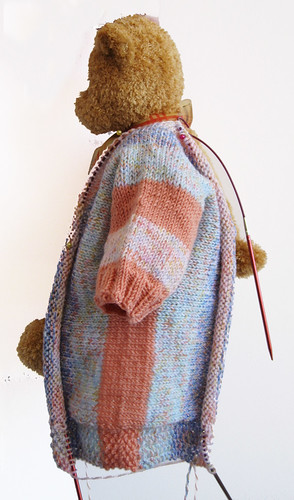
Basically, I am knitting a U-shaped object. The curve is the shoulder and the legs are the front and back sides. Here we are a bit further along.


Continuing on, I finish the shoulder area. Here's a side view.


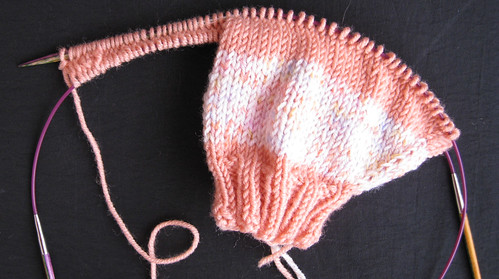
And then, the back and front must part ways for a while, because we do need a hole for the head. If you forget the hole, I suppose you could steek it, but that's way beyond my area of expertise. You are on your own if you decide to cut and sew.

For the neck area, instead of knitting back and forth over the entire garment, we shall knit the front back-and-forth and the back forth-and-back. Um. How about: The front and back are knitted separately to accommodate the neck area. The shapings are the same.

Once we have finished with the neck, the back and front have a joyous reunion at the shoulder.


When the second shoulder area is complete, I carefully isolate the sleeve stitches with markers because I tend to daydream and do stupid stuff like bind off the entire side, thus producing an inventive one-armed sweater. Do not ask me how I know this.

The yarn is at the bottom edge of the front. I turn the garment inside out and do a 3-needle bind-off up to the sleeve stitches.

And whipping out my trusty second circular, I finish off the second sleeve.

And finally, I pick up the neck stitches and do an inch of ribbing.


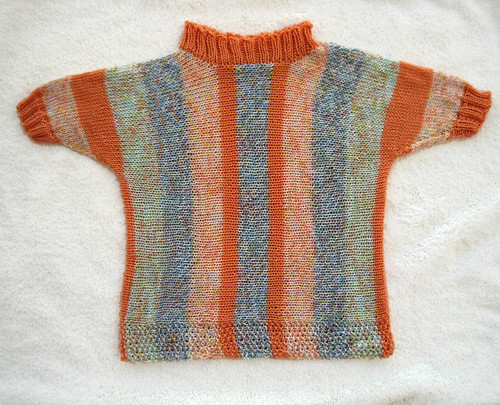
Here is the garment shown flat.


I used four colors of a weird yarn (Stampato Color Baby) that I found in a teeny yarn store somewhere. It's a nice 100% merino fingering weight and the garment needed about 300 yards with size 3 needles (size 2 for the ribbing). I changed colors every 12 rows, but if I were to knit a second sweater, I would use self-striping sock yarn, because weaving in all those ends were way too much trouble for a lazy knitter like me.

Pithy Directions

Using smaller needles, cast on 36 stitches and join in a circle.

Rib for 9 rounds (K2P2).

Knit 1 row.

Increase 4 stitches evenly across the next row. (40 stitches)

Change to larger needles and knit 1 row.

Increase 1 stitch at the beginning and end of every other round 9x. That is, increase 18 stitches. (58 stitches).

Cast on 39 stitches by wrapping the yarn around the needles 39 times. The 9 stitches at the bottom edges in the sample are worked in moss stitch. Alternatively, cast on 30 stitches and when you are finished with the rest of the sweater, pick up 96 stitches across the bottom and knit 9 rows of K2P2 ribbing.

Work 36 rows for the shoulder area.

Split for neck (front and back are worked identically):

Decrease 1 stitch at the neck edge 6x.

Knit 24 rows.

Increase 1 stitch at the neck edge 6x.

Join front and back by knitting without turning at the neck.

Knit 36 rows for the other shoulder.

Place markers for the sleeve--the easiest way is to count 39 stitches from the bottom edges of the front and back.

Turn the garment inside out and do a 3-needle bindoff of the body stitches. Or graft the 39 stitches together, if you like.

Place the 58 sleeve stitches on 2 circulars and decrease 1 stitch each side every other row 9x. (40 stitches)

Knit 1 row.

Decrease 4 stitches evenly across the next row. (36 stitches)

Change to smaller needles and knit 1 row.

Rib for 9 rounds (K2P2).

Pick up 96 stitches around the neck area with the smaller needles and rib for 9 rows.

Bind off really loosely--babys' heads are larger than you think they are.

Friday, November 2, 2007

Current and Future Knitting

What with all the swatching and illuminated yarn posts, I'll bet you guys thought I wasn't actually doing any knitting-related work. Well I have, and I also spent three days dying yarn for another project that I will talk about in another post.

Panache Sweater
I was rootling around in my yarn stash the other day and ran across 14 balls of KnitPicks Panache. It's a bulky yarn (40% baby alpaca, 20% cashmere, 20% silk, 20% extrafine merino) that they no longer carry. Too bad--it has a fabulously soft hand and excellent stitch definition.

It felt so nice that I yanked it out of my stash drawer (leaving a nice big hole to fill) and made this, with the design help of my KnitWare program:


The sweater is patterned after an old Annie Blatt design that I made 30 years ago. I never wore it--they yarn turned out to be too itchy for me--and I had to give it away. I made quite a few changes from the original--different gauge, yarn, ribbing, collar...but it's the same color and the puffed moss-stitch sleeves follow the original concept.

At 4.5 spi, it only took a week of pickup knitting to finish. I loved everything about the yarn except the quality control. Each ball of 68 yards had at least two knots. And these weren't your common tied variety either--the ends were glued together. Never encountered glue globs in yarn before.

Lyra
I reserve the early mornings for complicated knitting, and for the past month or so, have been working on Niebling's Lyra. This morning, I hit row 113. Of course, you can't see anything pretty in this red blob, but I assure you that it looks really cool when I hold it up to the light!


Socks
As always, I have a pair of plain socks for car knitting. These will be dress socks for Roy, which will go nicely with his tuxedo, assuming he gets around to buying one. The yarn is Adirondack Soxie--I don't remember what colorway.


Never Enough Nieblings
Finally, I started thinking about my next Niebling. Unfortunately, Harry is thinking about his next Niebling. This means that all the patterns are in a drawer under the waterbed, which Harry has fitted out as a luxury apartment, complete with an electronic lock that only responds to his legprint.

He emailed me a short list of choices and a long list of yarn that he wanted. As always, his choices are impeccable.

Lotus Flower


Adelaida

Pomegranate and Palm

Harry told me that he gets first choice, but I am welcome to choose one of his rejects and any yarn that he has tossed out of his apartment. How did this happen to me, reduced to groveling for patterns and knitting leftovers?

Fortunately, Harry knows nothing about the Princess shawl, as he has been immersed in decorating his apartment, ordering expensive food items from Balducci's, and scaring the figlets out of the UPS guy. Princess is mine, all mine!

Monday, September 24, 2007

Feminin Strik Comes to the USA!

Those who drooled over the Danish masterpiece Feminin Strik, but didn't want to pay the postage, can rejoice in the fact that Debbie Gremlitz of Nordic Fiber Arts will be carrying the book sometime in October.

There was also some talk about getting it translated in this Knitty thread.

Those who do have the book can participate in a loosely organized KAL for the Circle sweater with me and KnitYoga.

Got my yarn, got my needles, and even got my translation! Ready to roll!


Friday, January 5, 2007

A Lovely Summer Sweater

Lumiere is the perfect warm-weather yarn--it's cottony, but pleasantly springy to knit and it doesn't stretch out of shape after you wear the sweater. I purchased the yarn on impulse at a LYS last winter. It had just come into the store and I bought all she had there.


I really wanted a summer cardigan and Lumiere turned out to be an inspired choice for the sweater I had in mind. I designed it with Knitware, which I prefer to the Sweater Wizard. I own them both, but Knitware is more appropriate for the types of projects I design and just seems more flexible to me.

The sweater is a simple cardigan. The body was knit semi-roundly in a single piece and turned at the front opening. The shoulders were joined using a 3-needle bind-off, then the sleeves were knit by picking up from the armhole and were knitted down to the wrist. Finally, I added a border by picking up stitches all around the opening.

Notice there is not a single seam anywhere in this sweater. When you bind off the edging, you are finished.

The sleeves and border are moss stitch, but I used Butterfly stitch for the body. This stitch is great fun to do, but you have to be very careful to leave plenty of slack when slipping the stitches.


Patterns

Moss Stitch

Row 1: (K1, P1) rep to end

Row 2: (P1, K1) rep to end


Butterfly Stitch

Multiple of 10 stitches plus 9

Rows 1, 3, 5, 7, 9: k2, *K5, sl 5 wyif, k5*, End sl 5, k2

Rows 2, 4, 6, 8: Purl

Row 10: P4. *The next stitch is the center of the slipped group. Insert the right needle down through the 5 loose strands, bring the needle up and put the 5 strands on the left needle, then purl the 5 strands AND the next stitch together as a single stitch. P9* End P4

Rows 11,12, 15, 17, 19: K7, * K5, sl 5 wyif, K5*, End sl 5, K7

Rows 12, 14, 16,and 18: Purl

Row 20: P9, *gather stitches as for Row 10, P9*


Thursday, December 7, 2006

WIPS

I usually have three projects going at once--one for early morning coffee, one for after dinner and one for the car. I like to knit lace in the early morning when I can concentrate without anyone asking me for the, um, precise location some book nobody's read or mentioned for 20 years as in

"Darling, have you seen my junior high school math book? I need to review percentages again. Oh wait, can you just figure out what 17% of $87.45 is so I can send this off in the mail..."

This is my current morning endeavor (Peacock shawl from Fiddlesticks using Schaefer's Trenna in the Purple Violet Colorway. Trenna is only available from Little Knits. Link is in the sidebar).


Trenna is really a pleasant knit--not splitty, not slippery, with a nice, gloss to it. And it's very soft to touch.

After dinner I pick up a semi-mindless project like the Cheshire sweater. I did the cuffs in a variation of a twisted baby rib (knit in back of all knit stitches so they look neater). Such pretty yarn! The colors just flow back and forth in this lovely purple-green-blue wash.


Here's a close-up of the cuff:


Sock or some endless stockinette project are generally relegated to the car, waiting rooms, and places where instant interruptions will cause no great loss.

Here is an Adirondack Soxie sock...up the the gusset at this point. This stuff is just scrumptious to work with--tightly spun, springy, soft, and the colorway, Speckled Sea Mist, is nice and fresh. Ewe Need Yarn carries just about every color Adirondack offers (see the sidebar for the link) and I am embarrassed to admit that I ordered most of them.

I know it sounds a bit whiny, but Adirondack uses too much turquoise. I like turquoise, but it does see to find its way into almost every blend. More reds. Fewer turquoises.

Saturday, December 2, 2006

Cheshire Cat Sweater

Every year, I try to knit DH one sweater. He's a rather large guy, so it takes a long time to knit around him. Last year, I made him a Bohus sweater with a black background and I thought I had fallen into some sort of knitting black hole. Bohus sweaters, which I will post about at a later time, have highly intricate yokes composed of 10 or 15 colors, but the rest of the sweater is plain. In the case of last year's sweater, plain black. Totally plain black. Black, black black. The year before was a dark green Bohus. Green green green.

This year, I simply couldn't face months of plain color. I had bought some clever JHB cat buttons and wanted to use them as decoration. I poked at some yarn at a few LYS, but they were undistinguished and worse, plain blue, plain red, plain beige. Meh.

After grazing around the Internet, I decided that Lisa Souza's Alpaca Silk in the Wild Thing colorway was an perfect match to the buttons. The yarn is lovely to handle, too, with a fine drape and a bit of a silky halo.

The sweater will be a simple yoke, with baby cable ribbing at the sleeves, yoke, and neck. Here's a really really rough sketch:


I swatched the yarn. Although the recommended needle size was 4 or 5, I am a loose knitter, and size 3 worked better for this yarn, which is a bit slippery. The bottom half of the lower swatch was done with the size 5 needle, the top half with a size 4. The upper swatch was knit with size 3. the yarn blocks nicely and is very soft. I highly recommend this yarn as an alternative, to say, qiviut. Of course, a sweater out of qiviut would cost about $2000, with your color choice of boring brown, boring brown, and boring brown.


Aside: I made an earwarmer out of qiviut a few months ago. I will post on it at another time. Suffice it to say that this stuff is the most overpriced, overhyped fiber of the century.

I have already designed the sweater using Knitware, my favorite designing software. You can read about it here: http://www.greatknitdesigns.com/desc.htm.


I';m going to do the sleeves first, so I hope by next week I'll have something to show you.

Friday, December 1, 2006

The First and the Last

Starting a blog is a bit awkward, I mean, where do you really begin?

The first post was the much-requested no-hassle sock pattern, which was why I started the blog in the first place. I was tired of sending it out by email and private messages.

I am a book compositor by profession, and it just so happens that one of the books I am currently laying out is about blogs. It's one of the few books that I actually started reading (usually I just look at the layout and ignore the content). I had to stop compositing and finish reading, because the text was getting kinda raggedy.

But the book was so interesting that I began following the author's directions. I tried a few of his recommended blogging sites, and decided Blogger was the easiest to use.

I am sure that after a few months or so, the posts will die down to a trickle, but there is a good amount of backlog here, and many people have requested pictures and tutorials from me. So I set up my camera on a tripod, and will try to fill everyone's wish list (even Laura, who wants some pictures that belong in the late--and-much-lamented You Knit What!).

So, for the first real post, I present a wildly condensed knitting history, featuring only my earliest and latest finished objects.

I learned to knit when I was two years old. We lived in New York City and getting around in those days meant using the subway. Whenever my mother took me down into that appalling, noisy, black hole, I would start to scream. She, being an impatient person, decided that all the little brat needed was a distraction. So out came the knitting needles and some red yarn, and I apparently spent two years knitting a pot holder.

"Apparently," because no pot holder was ever produced that I could recall. About ten years ago I asked her about it, and she told me that she unravelled the darn thing after each knitting session, seeing as how (a) she had no use for a woolen potholder and (b) if I finished it, I'd probably start the screaming bit all over again.

At some point, we became affluent enough to take taxis, so the pot holder remains my first unfinished object. I have no desire to recreate it. RIP.

After that, we progressed to scarves (long since disintegrated) and other forgotten knitware. However, at the age of eight, I made my first sweater. I still have it and I still wear it, as she had me make it in a lady's size Small, so that I wouldn't outgrow it (all the women in my family are tiny).

Here it is:

Here;s a close-up--hard to believe that I was knitting with one color in each hand at that age.


And here's a close-up of the inside. Not bad, even 50 years later.


As she always was, she was correct about the sizing. It still fits, 50 years later. She purchased the yarn and pattern from a shop in Denmark. It was knitted entirely in the round up to the armholes on a ghastly circular needle, then the front and back were knit back and forth on even more ghastly straight needles. The shoulders were seamed and the sleeve stitches were picked up around the armholes and knitted down to the cuffs. A daring design for 1958, when almost everything was knitted flat and tediously seamed together.

I can still see her face when I cast off the last stitch and the sweater fell to the floor. Mother wasn't much on verbal expression, and her praise was rare. She picked up the sweater and turned it inside out, then showed me how to weave in the ends. Never did she block anything, so a little while later, I found myself outside in the snow wearing my brand-new sweater, which at that point, came down below my knees. Nice and warm.

When I came back inside, she had piles of Workbasket Magazine ready for me to choose my next project. I have no idea what it was, though. When I get around to going through my drawers, I will post pictures of some other antique FO's that I kept.

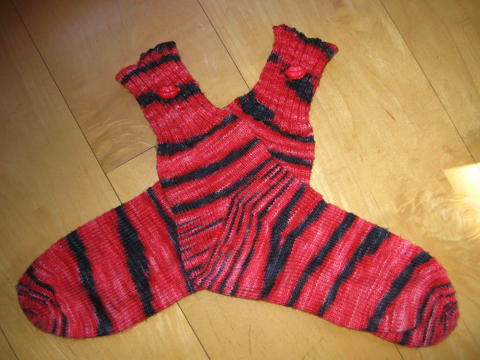
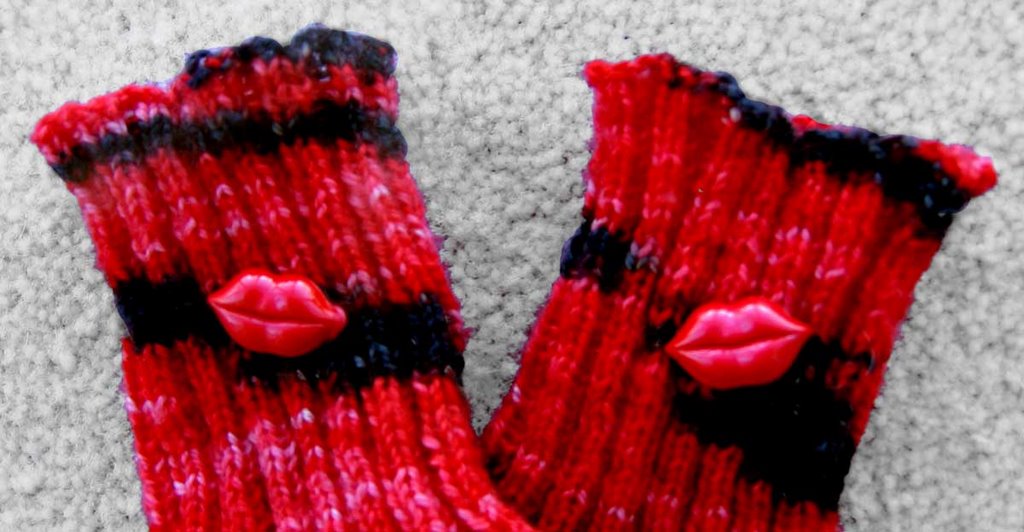
In the meantime, here is my latest FO: Little Devil Kissy Socks. The yarn is Lisa Souza's lucious Merino Sock Little Devil colorway. Pattern is the No-Hassle sock from the last post. DH (size 12) loves them and as worn them constantly for the last few weeks. I had to fish them out of the laundry bag to take a picture, so they look a bit rumpled.


Close-up of the buttons:


The buttons came from here:

http://www.craftconn.com/Main.asp?Task=Custom&Step=Notion+Category&StartAt=25&CategoryId=255.

The JHB buttons are just sweet. I bought some of the cheshire cats to use on a sweater that is currently almost in progress (still swatching).

The yarn is Lisa Souza's Alpaca Silk in the Wild Things colorway, also lucious. Lisa Lucious Souza, that's her. Check her out via the link in the sidebar on the right of this blog page.


Sometime during the next few weeks I will add lots of pictures to my sock tutorial. it's not so easy to take pictures of knitting-in-progress, so bear with me for a bit.