I know, the posts are few and far between. But, as I stated a long time ago, I only post when I have something to say that I think my readers would want to hear. Listens to the annoyed mumbles. Well it's true. You don't want me to start posting recipes for beets, do you? I could do that, you know. And add some pictures of the grandkids at Disney World. Looks offstage. Well, they don't have to know we don't have grandkids. I won't tell them if you don't.
==> Beet lovers, please, no emails, phone calls, or howlers.
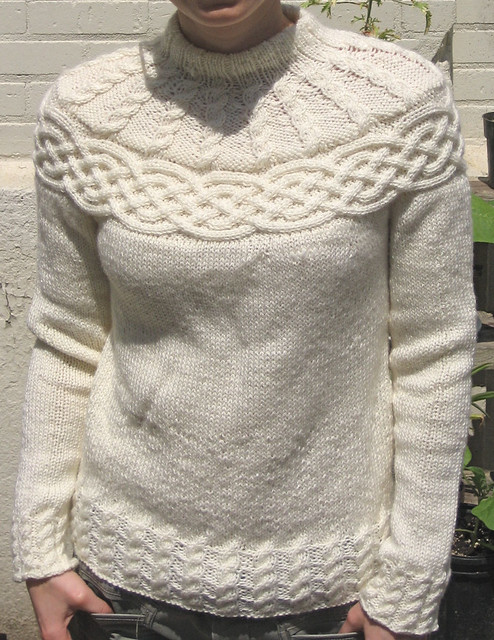
I haven't been blogging lately mostly because I haven't been knitting very much. I did finish a Bohus sweater, though. Considering it was knit with a heavy laceweight yarn, it took me a couple of months to finish. That's my excuse, and I'm standing by it.

Well, back to the rats. Those of you who spin know Neal Brand, a maker of exquisite supported spindles and, incidentally, a math professor. For this past term's project, Neal had his calculus students design the perfect supported spindle. He then turned a sample of each project on a lathe. The results are diverse, imaginative, and of course, incredibly beautiful. They can be viewed by cruising Neal's thread in Spindle Candy, starting around
here. Neal kindly allowed me to choose one of the designs and made me my very own Flying Saucer of Awesomeness.
In return, I offered to spin some yarn with the FSoA spindle and make each of the students involved in the design process their very own Flat Rat Bookmark, an item which no one, especially calculus students, should be without.
Note that if you have converted your entire library to eBooks, you can just drape your Rat over the top of your reader to keep it warm. (I notice that the pronoun "it" in the last sentence is ambiguous. The answer is yes, you can keep either the rat or the reader warm.)
The original design,
The Squashed Rat Bookmark, is cute, but I wanted something, um, rattier. You know, with a pointier nose, fatter body, and beadier eyeballs. And thus, I spent some time with needles and crochet hook developing a pattern so all of you can make your very own Flat Rat. Mine were made with fingering-weight handspun Tasmanian Corriedale, which, oddly enough, is the stuff Malcolm Fielding's spindles come wrapped in. I dyed the finished yarn Rat Gray, of course.
Here's a close-up of the completed Flat Rat.

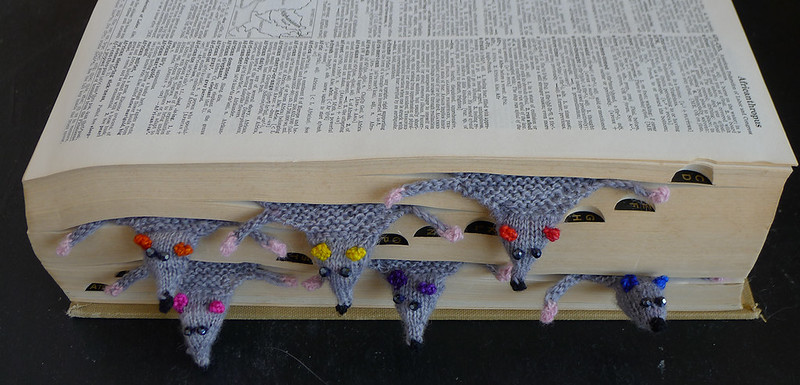
And here's photo of the Flat Rats in action:
When not in use, these rats stack well.
Head
Make a provisional crochet chain and pick up 18 stitches. Circularize on
two or more needles. I found the crochet provisional method the easiest
way to make the head. I made decreases on both sides of the head,
which produced a pointier nose than decreasing around a single stitch,
like you do for a sleeve.
knit 4 rows
knit 3, ssk, k8, k2tog, k3
k1 row
k3, ssk, k6, k2tog, k3
k1 row
k3 ssk k4, k2tog, k3
k1 row
k2 ssk, k4, k2tog, k2
k1 row
k2, ssk, k2, k2tog, k2
k1 row
k1, ssk, k2, k2tog, k1
k1 row
3 st left on each needle.
Join black yarn for the nose.
k1, ssk, k2tog, k1
knit 1 row
Run black tail through stitches, run black through stitches again until nose is roundish--about three times. Pull all ends inside of the head.
Stuff head.
Turn the head around and pick up 18 stitches in such a way that the decreases fall on the sides of the head and aren't obtrusive. Put nine stitches on each of two needles.
Do a 3-needle bind-off by knitting together one stitch from each of the two needles. That is, insert the third needle through a stitch on the front needle and a stitch on the back needle and knit both of them off. You now have 9 stitches. Or you should. If you have ten, well, just go with the flow.
Body
knit 2 rows
k1 kfb (knit in the front and back of the stitch to increase), knit to the last two stitches, kfb, k1.
k1 row
Repeat increases 2 more times, to 15 st. That is, increase row, plain row, increase row.
For the first leg, cast on 6 gray and 2 pink stitches by knitting on. Bind off two stitches in pink and the rest in gray.
Knit to end of row, turn and repeat leg on other side.
Resume increases 4 times until you have 23 st. After each increase row, knit a plain row.
Knit 9 rows.
Decrease back to 11 stitches via these two rows:
k1, ssk...k2tog, k1.
k1 row
Do another set of legs.
Repeat the two decrease rows three more times--you will have 5 stitches on the needle.
Bind off.
Bits
Crochet a chain for the tail. Double yarn between bound-off stitches, chain 17. Knot the ends and trim. Or knit an I-cord. The chain is flatter, but you will probably have to wet and pin it to make it lie flat. Mine curled up into pigtails, which would have been terrific if I were making flat piglets.
Knot pink paw ends together and weave in ends.
Ears are crocheted directly to the head.
SC in two stitches, ch1, turn, single SC, bind off, run ends through head. Or make any other teeny blob-shape using a needle, hook, loom, or potato peeler.
I dampened my rats and pinned them out to make them flatter...I hope PETA doesn't see this picture....
You could just squish the rat in an unabridged dictionary or a Uline catalog for a while if this concept makes you squeamish.
And finally, if you have no inclination to
knit a flat rat, you could make one using this handy method:
BIG NOTE
I want to remind everyone that I can't respond to comments without an email address, Ravelry name, or other means of contact. Too often these days there's just no way for me to thank you for your comment or answer your question. Along these lines, I notice fewer and fewer active Blogger profiles. That makes me sad, but as technology and social networking advance, sites such as Facebook and Ravelry have replaced blogging as a primary means of communication. And no, I don't have a Facebook or Twitter ID. I think Facebook and Twitter are creepy. However, you can always ping me on Ravelry if you don't want to leave a public comment.