If you hunt around the Internet in search of purl decreases, you will probably encounter only two: the right-slanting single decrease (P2tog) and the right-slanting double decrease (P3tog). There may be times, however, when you need single or double left-slanting purl decreases or a double purl decrease with no slant at all.
Most commonly, you will encounter these snarky decreases if you are knitting garter-stitch lace in-the-round, for example, a borders-outward shawl in a single piece. To maintain garter stitch in the round, alternate rows must be purled (unless you are cheating and going to futz one corner so you can knit back and forth). And if you are knitting Shetland lace, there's probably no way you will escape having to work double purl decreases with no slant. Central double decreases abound in Shetland patterns.
After perusing my standard books, such as Barbara Walker's Charted Knitting Designs, and rejecting most of the solutions as kinda awkward, I fiddled around with a few different ways of accomplishing these dratted decreases. Some people hate purling through the back of stitches. Others don't find this uncomfortable. Please try all these methods and decide which one works best for you.
Left-Slanting Single Purl Decrease
The most common method is purling through the back of two stitches thusly: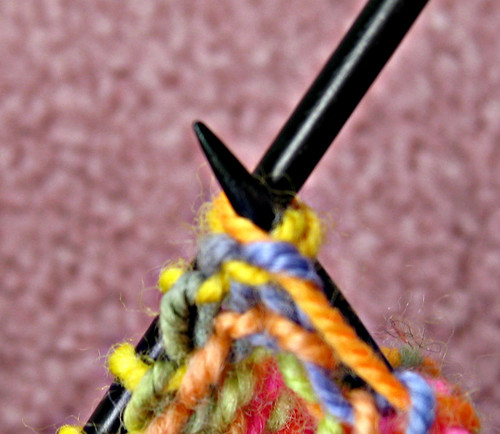
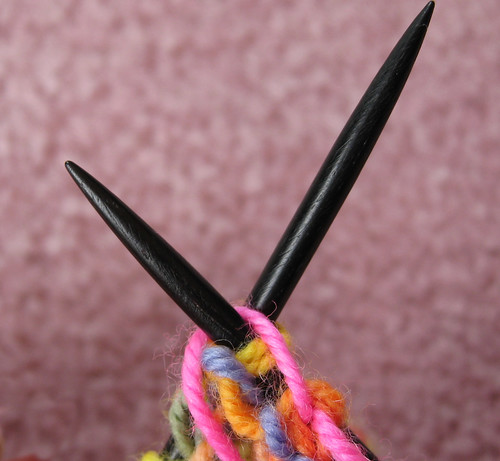
the finished stitch on the purl side: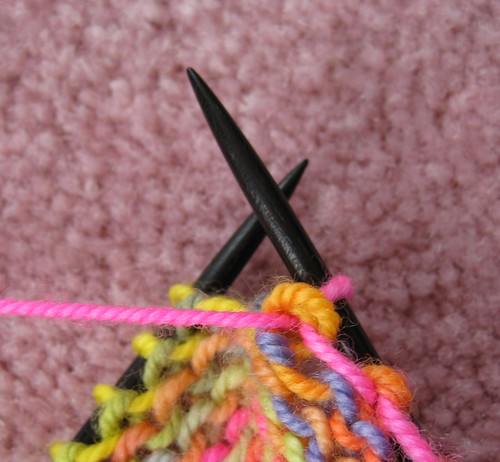
And finished stitch on the knit side:
If you hate this process, then slip two stitches, one at a time, knitwise.
first stitch slipped...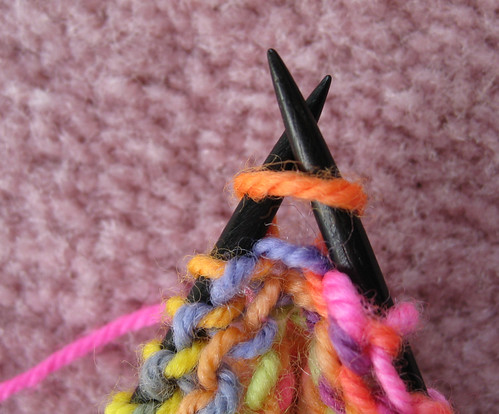
.... second stitch slipped.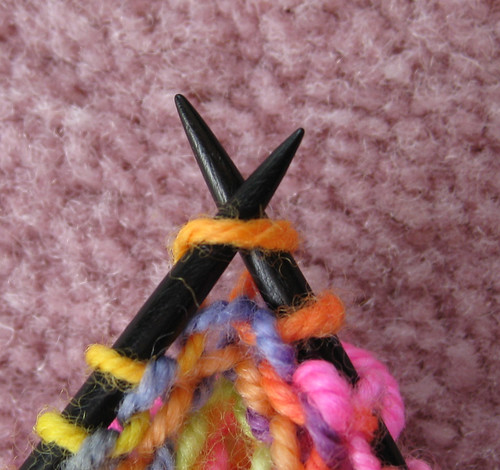
Then insert the tip of the left needle through the front of these two stitches (which are now on the right needle)...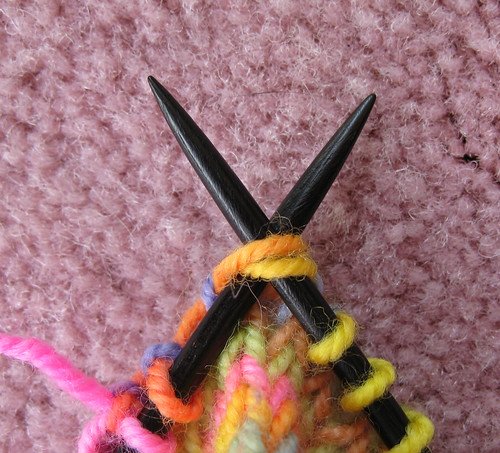
and slip them back to the left needle as a unit. Notice that the stitches have switch positions.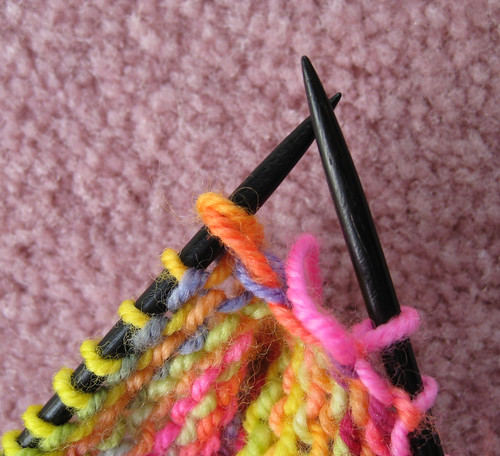
Purl these two stitches together.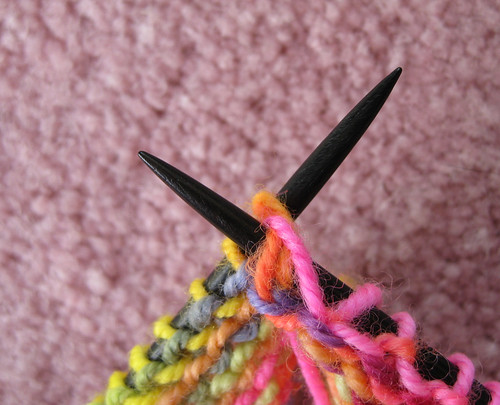
Here's the finished stitch on the purl side: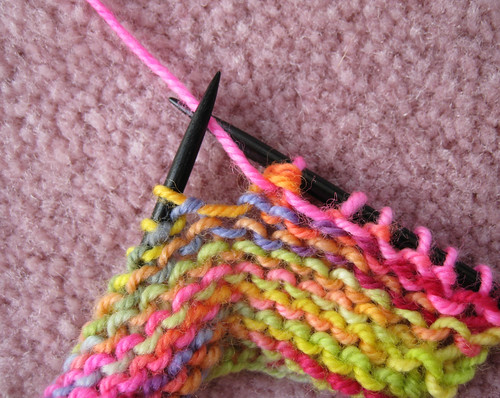
And here's the knit side:
The second method seems easier to me for purling together two stitches when one of them is a yarnover. But sometimes I just purl through the back. Which method I choose depends a great deal on the yarn--some yarns don't like the back stitch, some don't like the slip-and-flip business. Take your pick :)
Left-Slanting Double Purl Decrease
This is just an extension of the single decrease, but with added torment. No matter which method you use, the process is awful. My favorite method, not described here in detail, is to avoid patterns that require me to do this.
Anyway.
You can purl through the back of three stitches: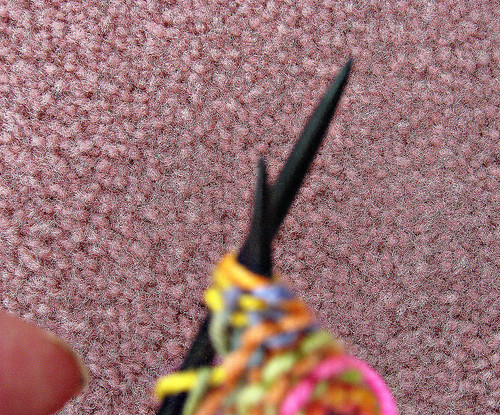

Here's what it looks like on the knit side:
Or, slip three stitches, one at a time, purlwise.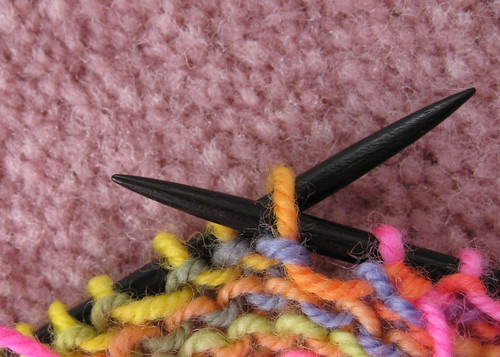
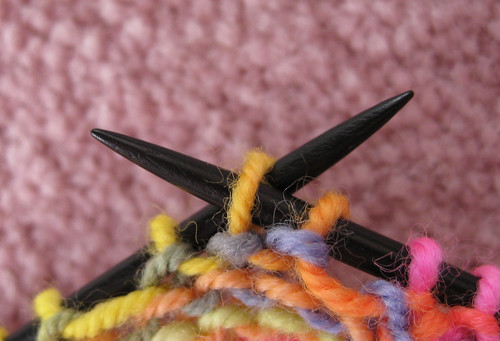

Then insert the tip of the left needle through the front of these three stitches (which are now on the right needle),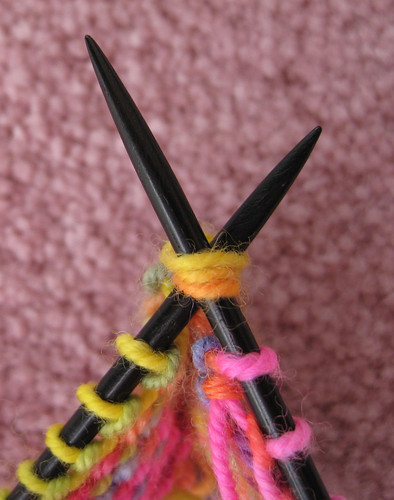
and slip them back to the left needle as a unit.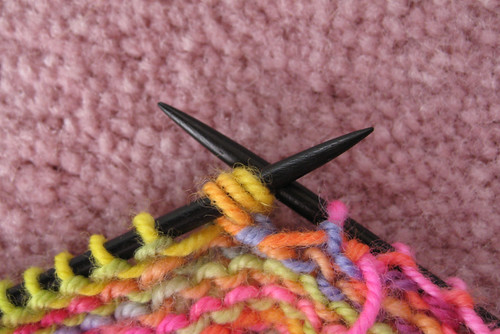
Then purl these three stitches together.
Here's the purl side: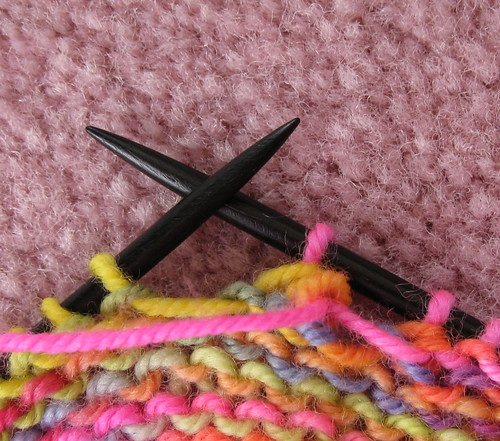
The he knit side looks the same as knitting 3 stitches together through the back loops as shown above, so I didn't take another photo.
Yet another method is described in the Walker book. Purl two stitches together. Keeping the yarn in front, put the stitch back on the left-hand needle. Pass the next stitch over this one, then transfer to the right-hand needle. I frankly don't care for the way it looks, but it's simpler to execute.
Double-Purl Decrease with No Slant (Central Double Purl Decrease)
This one is actually pretty easy. The literature I encountered had some wacky solutions; I think my answer is simpler. The first two steps are identical to the Left-Slanting Single Purl Decrease shown above.
Slip two stitches, one at a time, knitwise.
Then insert the tip of the left needle through the front of these two stitches (which are now on the right needle), and slip them back to the left needle as a unit.
Purl three stitches together (the two you slipped and flipped, plus one on the left-hand needle).
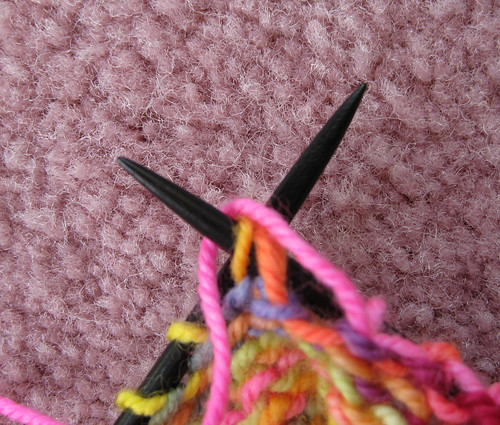
Here's the finished decrease on the purl side:
and the knit side: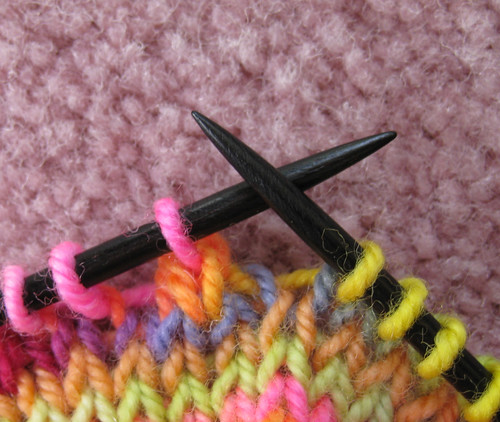
Wednesday, June 10, 2009
Purl Decreases Demystified

Wednesday, June 3, 2009
Queen Ring Shetland Center--Complete!
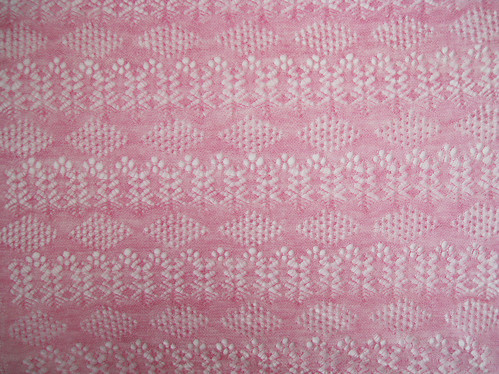
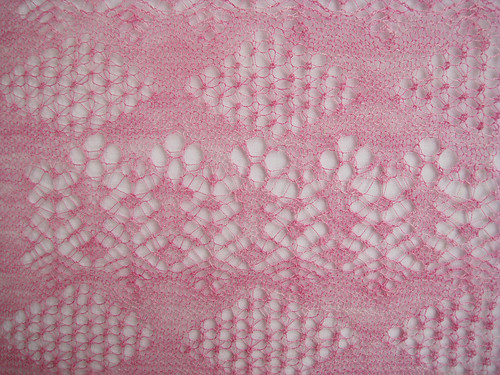
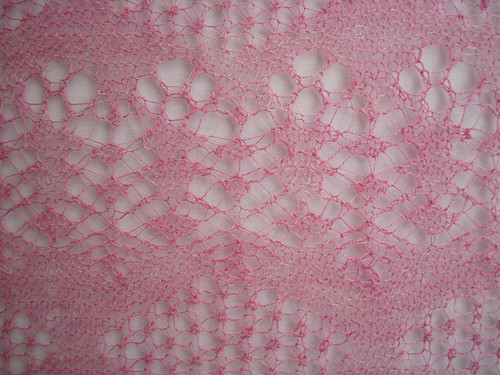
And the yarn! Technically, it's 52/2 60% merino, 20% cashmere, 20% silk. But to knit with it--it's incredible! It's stupendous! It's incredible! Oh whoops, I said that. It's bouncy. It's silky. It's soft. It's everything a gossamer yarn is supposed to be. It deserves a niche in the Yarn Hall of Fame.
Alas, I bought the only skein in the universe on my trip to Japan last year. I was so besotted with it that I decided that I had to have more.
I sent a sample to a mill in China and asked what their minimum order was for a custom spin. The bad news was that I needed to buy 50 kilos. Much as I loved it, I didn't love it 50 kilos-worth. Each kilo has 25,000 meters, and, while I am a fairly robust knitter, I couldn't see my way to stashing 1,250,000 meters of yarn. There are limits, even for me.
I figured there were probably a few other people who might go in with me on the buy. I posted the information in the Heirloom Knitting group on Ravelry and placed a little Post-It note next to the computer to write down the names of the five or six people I figured would want a kilo or two. To my utter bafflement, I had to quickly switch to a spreadsheet to keep track of the orders.
The good news is that I have 100 kilos subscribed. In about a month, I will be able to roll around in the stuff (just kidding, guys, really!)
The thought of 200 pounds of yarn landing in my yard is a bit daunting, but a dear lady is driving down from South Carolina to help us pack and ship the 2,500,000 meters of the yarn I am naming Phoenix.
Of course, Harry said he would help out by providing the entertainment. Unfortunately, he has developed a crush on Al Jolson. The house reverberates with the clickity-click of eight little feet tap-dancing on the dining room table. I can't wait to see what he has in store for us as we wrestle with mailing bags. Hmm, perhaps he will fit in one of them. (Joke--it's a joke!) I promise that nobody will open their package and find a tap-dancing spider in it. Unless, of course, you want one.
Wednesday, May 20, 2009
Knitting Rules of Thumb
Every so often, I come across an approximation that makes sense, is easy to remember, and I actually write down in my knitting notebook under the heading Cool Things That Are Easy to Remember but I Forget Anyway. I was flicking through said notebook the other day looking for something I have already forgotten about, and stumbled across the list. Because I am feeling way too lazy to photograph the center of the King Bat (aka Queen Ring) shawl that I finished a few days ago, I figured the list entries might come in handy for some of you. And make me feel less guilty about not stretching, pinning, photographing, cropping, uploading, and so on and so on.
Please remember that these are Rules of Thumb, not Inviolate Laws of Physics. If one or the other doesn't work every time, perhaps you could arrange for a different thumb or something.
- If you don't know what needle size might work best with a mystery yarn, thread the yarn through your needle gauge. The best fit is a good size to start with for regular knitting. For lace, try doubling the needle size.
- Don't want to (or can't) measure someone's foot? The length from the tip of the index finger to the base of the thumb is about equal to the length from the toe to where the foot connects to the leg (measured at the top of the foot). I discovered this one day when I put my sock over my hand. Why did I do that? I don't know.
- The measurement from the base of your thumb to the inside of your elbow is the same as the total length of your foot. Seems incredible, but it's true.
- If you stretch out your arms and measure from fingertip to fingertip, the length is the same as your height. You might find this useful when knitting shawls (Thanks, Carla!).
- The circumference of your wrist is about equal to the circumference of your foot at the arch. I have never needed to know what my arch circumference is, but I am sure there's someone out there who has been panting after this fact.
- The sleeves of an average sweater uses 1/3 of the total amount of yarn; the back takes 1/3, and the front 1/3. If you are not sure that you have enough yarn, knit the sleeves. Then you can adjust the body by, say, making it shorter, using a different yarn for the yoke, or blending in another dye lot.
- A cable takes about 10% more yarn than knitting the same stitches flat. This is an important rule of thumb if you decide to add some cables to a plain sweater--you'll need to cast on extra stitches or the fit of the sweater might be a big surprise. Actually, it would be a small surprise, but you know what I mean.
- Changing the size of your needle will change the gauge by about 1/2 stitch per inch for each needle size increment or decrement.
- One row of knitting uses about 3 times its length in yarn. This is a nice factoid for long-tail cast-on that eludes me every time I do a long-tail cast-on.
- According to the folks at Elann, if the gauge of a single strand of yarn is X stitches-per-inch, the gauge when used doubled will be X*.7.
- Also via Elann--if the project requires X ounces of yarn used single-stranded, it will require X*1.4 when used doubled.
- If you want to make a circular shawl, the general rule for increasing, is to increase four stitches every round, eight every other round, 12 every third round, or 16 every fourth round. There's some geometric flim-flam going on here. Please don't try to explain it to me.
- Eight increases/decreases every second round will give you a flat knitted circle. Six increases/decreases every round in single crochet will too.
- If you make six increases every second round, then knit x rows (where x is the number of rows with increases that you just made) then decrease six times every other row, you will get a ball.
- Two increases/decreases in the center of every second row will give you a 90 degree angle. That one’s pretty obvious, but it’s so useful.
- The last row of a project takes as long to knit as the rest of the entire sweater/sock/hat/scarf. This is a prime example of the Time Dilation effect.
Friday, May 15, 2009
Easy Go: The Sequel
Thanks so very much to everyone who made room in their homes for last week's offerings. Harry was delighted to learn that I didn't sell the hot pink eyelash yarn. However, what I didn't mention to him was that I had cut that grisly stuff into small bits and auctioned it off to the neighborhood birds. The nests look a bit, erm, exuberant, but at least they all match.
The back yard now resembles a miniature South Florida neighborhood. One enterprising family of chickadees further adorned their home with tiny pink flamingos. (I don't want to know where these came from.) Unfortunately, the yarn clashed horribly with Mr. and Mrs. Cardinal, who finally convinced me to trade the lurid pink for some equally regrettable twinkly fun fur. Their nest looks like a Las Vegas casino, but it sure is cheerful.
This week, I am listing a few more lace yarns, but most of what's here is sock/fingering weight. My Paypal address is sglinert--feel free to send me money and I will send you your yarn. Don't forget to tell me which yarn you want in the Paypal comment section. Or you can just email me, if that's more convenient.
$60 including US postage
$18 including US postage

100% Merino 370 yards
$12 including US postage

100% Merino 370 yards
$12 including US postage


Seacoast Handpainted Superwash Sock-Pink/Green/Beige
100% merino 560 yards
$21 including US postage

Unique Sheep Merino Sock-Blue/Purple
75% superwash merino, 25%mohair 346 yards
$17 including US postage

Claudia Handpainted Sock-Oops (2 available)
100% merino 350 yards in BOTH skeins
$21 including US postage

96% cotton, 4% Lycra 460 yards
$16 including US postage

Greenwood Fiberworks Cotton Lycra Sock Yarn--Black
96% cotton, 4% Lycra 460 yards
$16 including US postage

Greenwood Fiberworks Cotton Lycra Sock Yarn--Green
96% cotton, 4% Lycra 460 yards
$16 including US postage

Thursday, May 7, 2009
Easy Come, Easy Go
Well, it was certainly an eventful day. With no notice whatsoever, my company shut its doors. Worse, it shut its doors owing me a lot on money. I was also bemused to see my name spelled incorrectly on the severance letter, which sternly admonished me to refrain from discussing anything about this incident with anyone, including family pets, houseplants, or myself.
On the bright side, Harry offered to contribute to the household income by accepting a karaoke gig in Bulgaria. He then threw himself into a bottle of sake, where he has remained for most of the afternoon.
While he is in his state of inebriation, I was able to get into my stash again and sort through it.

Wednesday, May 6, 2009
Why Knot?
I love the Internet. While lounging around in my ratty shorts and t-shirt, I can go anywhere and discover just about anything except how to get rid of giant spiders that steal my stash, hoard my needles, and filch my patterns Harry. During one of my epic wanders, I stumbled upon a truly cool site called clanbadge.com.
Daniel sells a font that charts Celtic knots. I cannot imagine how many hours went into the design, but the results are simply amazing. The site is a bit confusing, so here is the link to the Charted font.
For example, by typing the following into Microsoft Word:
qe
zc
And then applying his font, I get the following little design: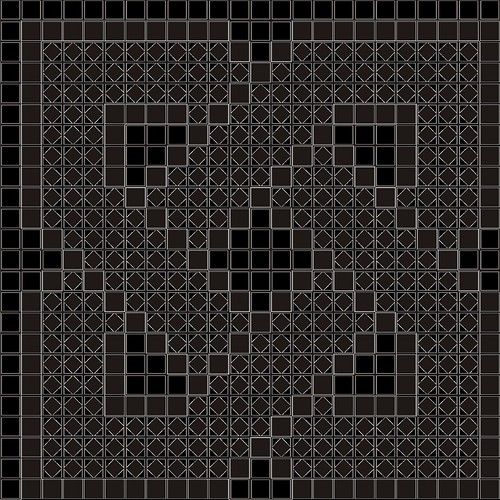
Well, that might be interesting to cross-stitchers, but maybe not so interesting to knitters. That is, until I apply some knitting symbols to the design.
Naturally, the first thing I thought of was lace. There are several ways to treat the motif. It can be outlined with yarnovers thusly: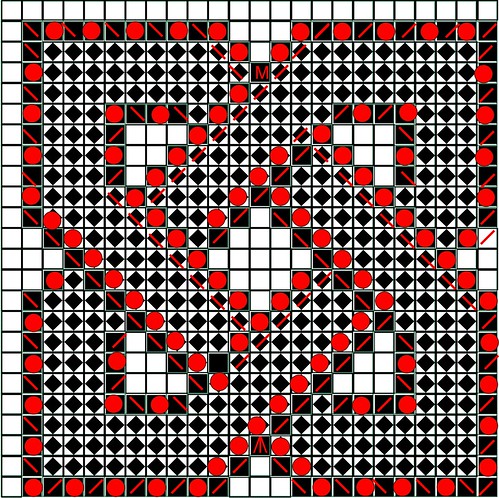
Or the interior can be filled with a small pattern: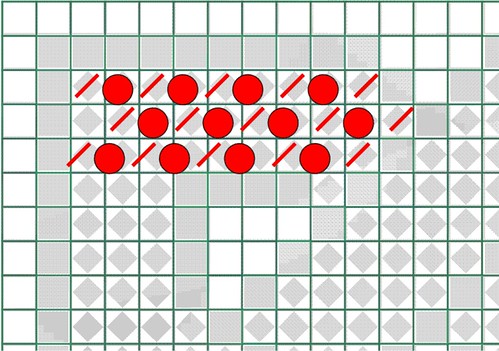
Of course, these designs can be knitted without any holes at all. Cable lovers can go insane knitting something like this: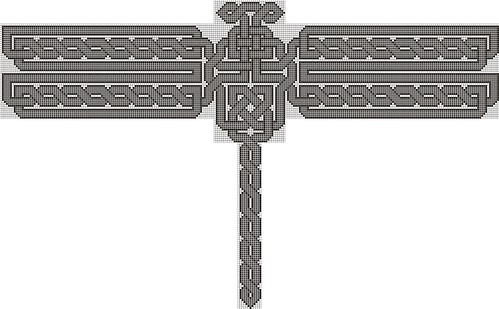
For those who like colorwork, a bit of paint to the following would make an interesting (and confusing) sweater motif.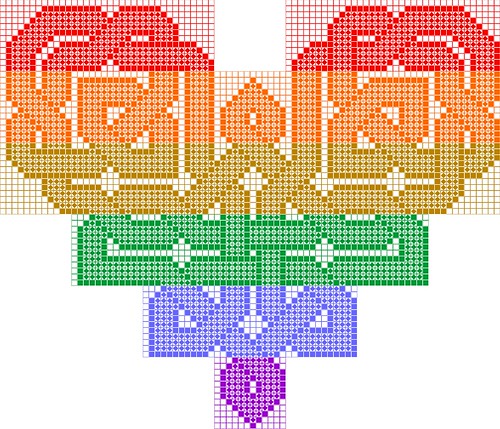
If you want to purchase the font for charting, make sure you buy the Charting font. Daniel also offers several other fonts, for example outline, 3D, and inverse, and filled. This page shows some beautiful examples of Celtic knots applied to a variety of crafts such as woodworking, quilting, metalsmithing, stained glass, and ostrich egg carving. Daniel offers a pattern pack for the chart font and there's a page of fancy knots that users have posted, which you can find here.
I would love to continue this post, but unfortunately, Harry just pulled the plug out of the compu
Wednesday, April 29, 2009
How To Go Off On a Tangent

These extremely fine shawls have been traditionally knit by ladies in and around Orenburg, Russia. The designs are quite geometric and the construction unique and efficient. The traditional yarn--goat down plied with thin single-ply silk--is handspun on lightweight supported spindles.
Unlike Shetland shawl knitting, which is popular enough to support commercially available yarn and a wealth of patterns, genuine Orenburg yarn cannot be purchased and charted designs are basically limited to those in Galina's books. In fact, Ravelry's knitqueen05 has knitted most of Galina's patterns--over and over and over. Yike!
I am intrigued by the fineness of the spinning and the luxurious feel of these shawls (I got to fondle them at the Skaska booth at Stitches South). I am intrigued enough to actually think about spinning again. (Opal, I don't want to hear about it.)
The thought made my brain cramp--I was shearing sheep and spinning before most of you were even born. My flock of rare non-white sheep and the byproducts thereof put me through graduate school.
I can't say that I enjoyed spinning. I recall with a grimace the lady who brought me Samoyed dog combings every year so I could spin sweater yarn for her. No matter how carefully or with what I washed the yarn, it retained its appalling dog odor and had to be dried as far from my house as possible. Worse, my cats hated the stuff and I had to leave it hanging in the barn lest it get clawed back into fluff again.
However, I did win several blue ribbons at the state fair for my fine skeins of lace yarns (90 wpi!), so the thought of spinning yarn for an Orenburg doesn't make me faint.
Times have changed since the 60's, when only a few types of wheels were available for purchase. As I wandered around the Internet spinning sites, I chanced upon the perfect solution for whipping out fine yarns without straining the shoulder or knee.
Warning!! All you spinners out there are about to toss rotten tomatoes at your screen. Spinning snobs should exit now!!!
Look: an electric charkha!

Fetchingly made from PVC pipe, a wheelchair wheel, and a knitting needle, Babe's Electric Liten Spindle Charkha Wheel entranced me. It weighs only two pounds and disassembles into a small box of giblets for compact storage. It's made for spinning gossamer-weight yarns and the motor assures a nice even pace for drafting.
I haven't quite justified the cost to myself yet. I may decide that the entire concept is too much trouble and just use some gossamer-weight cashmere to knit an Orenburg. On the other hand, new horizons beckon. I wouldn't want to get bored, now would I?
Harry, of course, thinks the concept is wonderful. At last he will have someone who can repair his disgraceful web. "Male spiders may knit, but they don't waste their time producing spider silk," he sniffed. "And cashmere batt will make an excellent mattress."
Sunday, April 19, 2009
Going Bats
A well-written pattern is akin to a gripping novel--tightly plotted and suspenseful, and a satisfying denouement with all the loose ends tidily wrapped up. A poorly written pattern, on the other hand, reminds me of a badly produced movie--terrible acting, disjointed, confusing plot, and loose ends galore at the end.
Occasionally, I will run across a pattern that makes me snicker. For example, any production with the line "Reserve at least 10 hours for sewing together" is, by definition, a genuine howler.
When I encountered this particular direction in the Queen Ring shawl, I giggled for at least ten minutes.
The original shawl is knitted from the borders inward. I don't like that construction for a number of reasons, not the least of which is the epic sewing-bits-together at the end. I wouldn't mind the sewing so much if it produced an attractive finished product. It doesn't. Sewn-together seams look ugly and I won't use them.
The second problem with the original pattern is that only half of the border is neatly mitered around the center's corners. The other two sides are stretched into shape during blocking. The stretching might work if the shawl is knitted with a nice, compliant wool yarn. It probably won't work with something like cashmere/silk yarn, which has the elasticity of a watermelon. The fact that the corners in the lovely photo are scrunched together and not viewable makes me uneasy. I want fully mitered corners that won't produce an unpleasant surprise after hundreds of hours of intense knitting.
Thus, I regraphed the shawl to be knit from the center outward, which means the border is picked up around the center square and knitted around and around (and around and around and etc. etc., and so forth....).
This process has its own inherent problems. First, the border itself must be inverted, because it's being knitted from top to bottom instead of bottom to top. Anyone who has ever reversed a pattern knows that it's usually impossible to simply turn it upside-down. And then there is the tedium of having to purl every other round in pattern to maintain the garter stitch in circular knitting mode. I tried a number of different fake corners to avoid the purling, but didn't care for the results.
Unfortunately, at some point during this epic graphing production, I took a well-deserved break. When I returned to the computer, Harry had redesigned the shawl border to suit his bizarre awful regrettable erm, unique taste. He had lopped off the seed pods (a decision I applauded) and substituted the never-before-revealed Shetland motif: Flying Bats.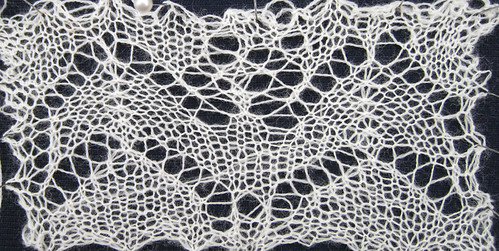
Harry announced that he just adores bats. I was a bit puzzled when he uttered that statement, because airborne insect-devouring predators just didn't strike me as arachnid-friendly. However, Harry pointed out that bats make exceptional targets and he enjoys plinking at them with his custom-built Barrett Model 82A1 .50 caliber sniper rifle (with BORS optics).
I also took issue with his introduction of non-traditional motifs into a mostly traditional Shetland shawl. I have this uneasy feeling that, after having worked his bats into the shawl border, I will open the door and find a mob of enraged Shetland Islanders bearing torches and brandishing pitchforks. But Harry pointed out that our designs often begin with a healthy respect for tradition and end up, well, different than the original pattern.
So, here's a bit of eye candy for you. It's one repeat of the center. The shawl is being worked in a 52/2 yarn composed of 60% wool, 20% cashmere, 20% silk that I purchased at Avril and dyed myself. Alas, there is no more of it, which is a real loss to the lace-knitting community. It's a lovely knit.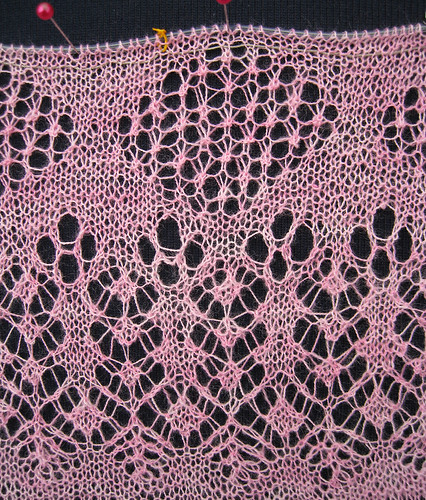
Sunday, April 5, 2009
Irtfa Irt'fa Irt'faa Irt'fa Irtfa'a...Oh, heck, dark purple Faroese shawl
My mother, who could out-curse any five drunken sailors, was (incredibly) an English major at NYU. I was therefore subjected to considerable cruel and unusual punishment during my formative years. From age 7, I was tasked with solving the New York Times crossword puzzle every morning before I left for school. Worse, when I achieved the lofty status of a tenth-grader, I was required to work it out using a pen.
I finally rebelled when she dragged out the typewriter sometime during my senior year. I think she was desperately trying to train me up so I could beat the socks off my Uncle Stanley, who could actually work the London Times crossword with a typewriter, a feat even my mother couldn't match.
The result of all this brain-twisting was that a) I knew more obscure words than my teachers and b) I was a whiz at spelling. At least I was a whiz at spelling before I encountered this shawl.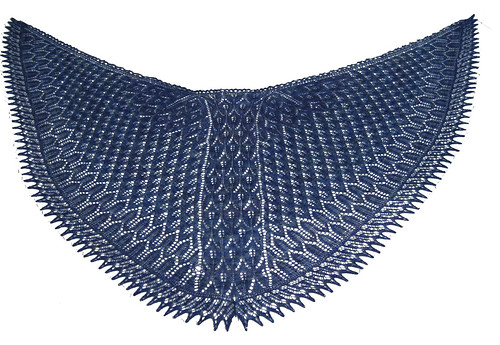 An Ann Hanson Faroese-style design, the final product is indeed lovely and doesn't slide off the shoulders, thanks to the top shaping. The knitting, alas, got a bit tedious.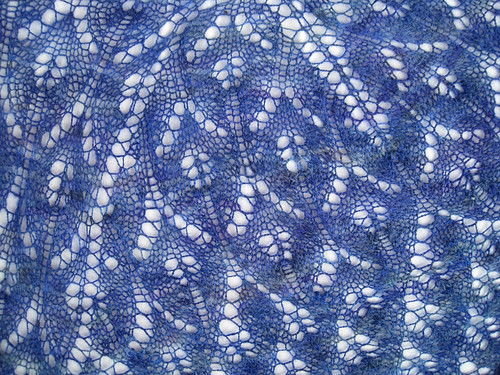
I designate patterns of this type as "Beer-Bottle Shawls." Wait--it's not what you're thinking! I am referring, of course, to the repeat accumulation. One repeat on the needles, two repeats on the needles, three repeats on the needles....100 bottles of beer on the wall etc. blah.
By the time I have worked five repeats, I start looking for tax forms to fill out in lieu of knitting another row of The Same Thing Over And Over. After 10 repeats, I avert my eyes when I walk by the WIP's little plastic bag. But, after a few weeks of avoidance behavior, I generally sit down, plug into some music, and finish it off.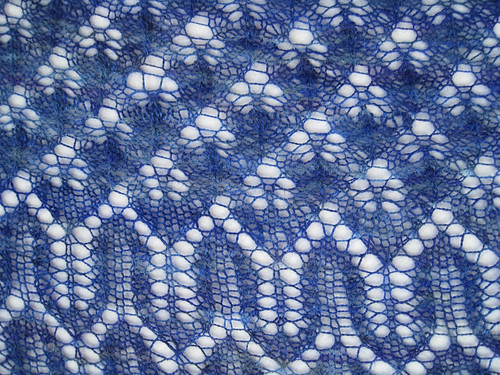
It was a simple knit and I adored the feathery edging. The real joy of the shawl was the yarn: 2/16 Lamoramere Fine Lace Blend (50% Cormo Lambwool, 40% Angora, 10% Cashmere), from Running Wild Farms. It's soft, lofty, springy, has a very fine halo, and dyes beautifully. I bought a skein of white and hand-painted it in dark blues and purples.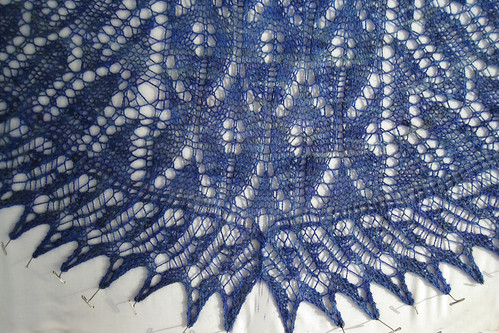
I did modify the edging pattern by knitting all the stitches in both directions. Life is too short to do all the purling acrobatics required as written.
Thursday, March 26, 2009
Odds and Ends
A Cure for Knitting Ennui
A few days ago I was flipping through my pattern collection in search of Something Different. At last count, I've been knitting for 58 years (urk!), which means I am abysmally jaded. The old saying "What Goes Around Comes Around" certainly applies. The same sweaters/hats/scarves/dishcloths/tippets have gone around and come around so often that I can point to a picture and recall at least five previous incarnations.
I was grazing through this season's knitting magazine offerings and for the first time I can remember, I bought neither Interweave Knits nor Vogue Knitting. The offerings in the former were tired and the projects in the latter made me laugh.
Fortunately, I have a dear friend in England (Thanks, Jo!) who faithfully traipses to her news agent every month and ships me a lovely package of Across-the-Pond knitting magazines. Although Simply Knitting is for the beginner/intermediate knitter, every issue carries an Alan Dart toy pattern, and I dearly love these. I couldn't resist this one: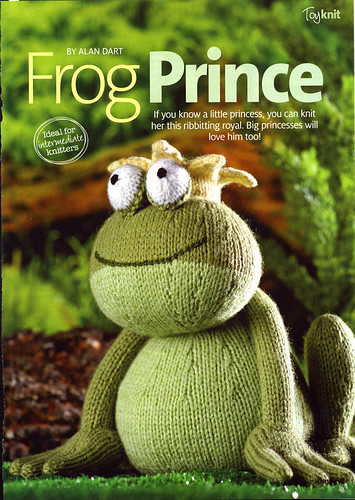
It went right to the head of the queue. The yarn is sitting in front of me waiting for me to finish this blog post.
Some brilliant English publishers thoroughly perused American knitting magazines and decided that they could do it better. And they certainly did! My last two care packages included an issue of a brand-new offering entitled The Knitter.
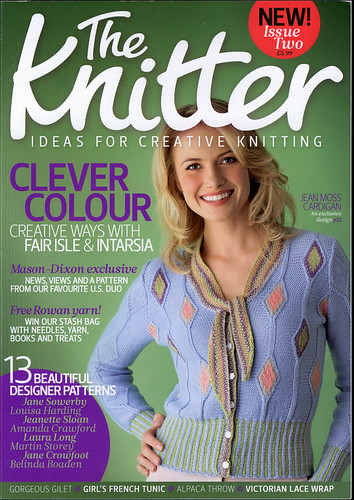
A few sample photos:
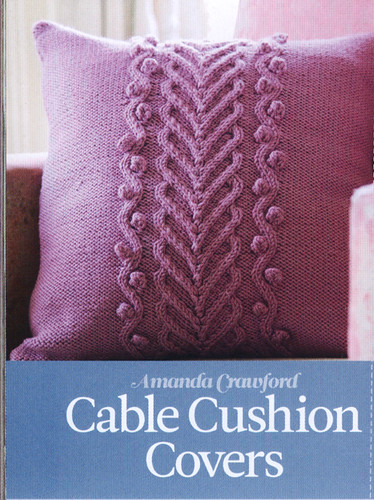
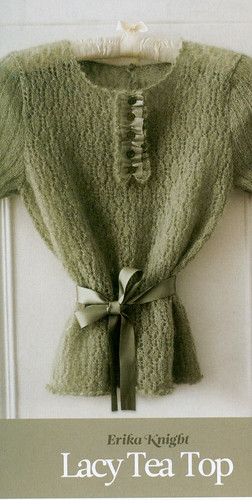
Intended for the experienced and adventurous, the two first glossy issues have been inspiring and beautifully laid out--treasures of knitterly eye candy. The only problem with it is that the magazine is not yet available in the US. I hope the publishers will consider overseas distribution, because advanced knitters here will surely snap up every issue. It's apparently available at bookstores and yarn shops in the US and Australia, so go get a copy!
Pattern Obscura
There's a wonderful thread on Ravelry entitled Favorite Obscure Patterns--I cruise through it often (Warning! Big Time Sucker!). Thanks to the diligence of the posters, I've added an embarrassment of items to my queue. The Internet also offers zillions of patterns that never seem to rise to public acclaim, and I want to tweet my kazoo about two of my recent favorites.
The first one is a lace shawl called Something Wicked Comes This Way, designed by Karen Walker. It's stunning! It's unusual! You can purchase it here. Go ahead--you know you want to!
--Photo Courtesy of No Two Snowflakes/Karen Walker (Thanks!)
The second pattern comes from the famous White Lies Designs. However, I haven't seen anyone get excited about this pattern... ....but I think it's eyepopping. And I have sufficient Yubina worsted-weight cashmere to make it. I have asked Harry dye the yarn for me in the requisite luscious shade of crimson, and he's agreed to do it in exchange for our new car and a year's supply of chocolate-covered beetles. A fair trade for him.
Yarn Obscura
Artist's Palette Yarn is one of my favorite Internet stores. Yes yes, she's in England. but the postage isn't punishing and the yarn will make you weep with delight. I've purchased a variety of her offerings--the quality is superb and the dying exquisite. Do give her store a try if you are looking for a little treat. Here are a few of her many types of yarns.
Glisten is a luxurious 2-ply 100% silk yarn, soft as down. I actually bought all four skeins--1200 yards will make a lovely shawl. Sorry, folks.
Damsel is 80% Extra Fine Merino 20% Silk cobweb weight, with 1200 yards per skein. She's currently having a 20% off sale. Don't you hate it when I tell you things like this?
And finally, I want to also report that I have also fallen in love with the yarns from No Two Snowflakes. Her stock isn't extensive and goes quickly, so you'll have to regularly troll her Etsy shop and see what's available. I snagged a skein of Roses and Lilacs cobweb-weight silk:
...and two skeins of Juicy Nectarine cobweb weight 50% silk, 50% wool.
Have fun grazing!
Sunday, March 1, 2009
Iris
I have to admit that I started Susan Pandorf's Iris stole with more than a little trepidation. The skeins of Handmaiden Seasilk (Mermaid colorway) looked unpleasantly brown to me and I wondered if the final result would be at all similar to her sample. The answer is yes--and it's quite stunning in person. Alas, the photos can't convey the beauteous shimmering of the silk or the glitter of the lovely beads.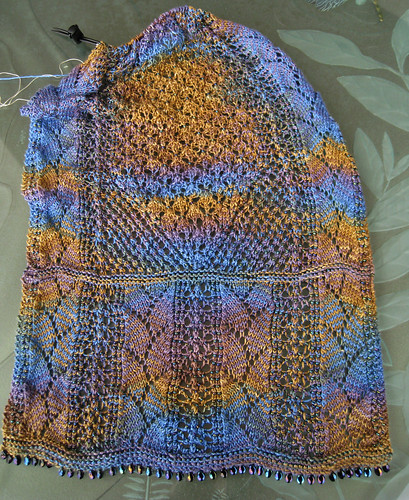
This is not a project for the impatient. There are LOTS of beads in this stole. Worse, the Seasilk is quite heavy and the #8 beads quite tiny. Most of the crochet hooks I tried could not pull the entire yarn through the bead hole.
The first few hooks I tried grabbed only a few plies of the yarn, producing a sort of shredded furry carpet of Seasilk (not quite the effect I was looking for). I finally dug out my mother's Really Old Boye #12, and that hook worked perfectly, although considerable force is required to yank the yarn through the little bead holes).
I compared my set of hooks to my mother's and discovered that hers have a much deeper hook than my newer Boyes. I immediately took myself off to eBay and found an identical backup hook in case the first one broke.
I have several other projects of Susan Pandorf's in the queue, most of which use the same yarn/bead combination. For the next one though, I ordered Delica beads, which have larger holes than the seed beads I used for Iris. The Delicas slide easily onto the Seasilk without a pitched battle.
I am about 3/4's finished with the first half, so this stole won't be completed for a while. Once you get past the intriguing triangular area shown below, the pattern becomes repetitive (and not terribly interesting to knit).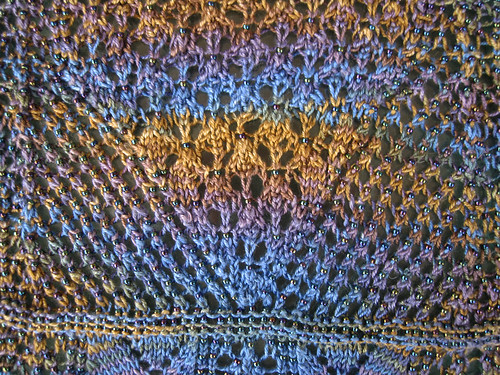
I figure it will be finished around the time it becomes too hot to wear it.

