Fleegle's Blog

Friday, July 10, 2009

Harry's King Bat--It's Alive!

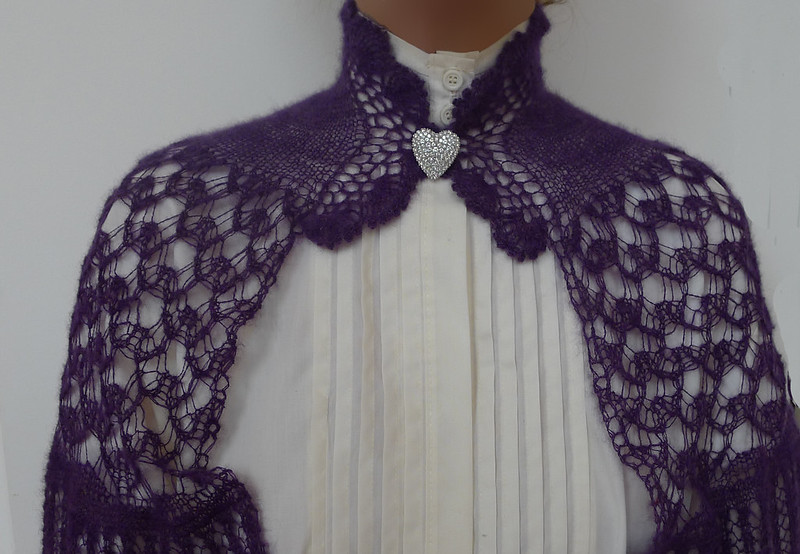
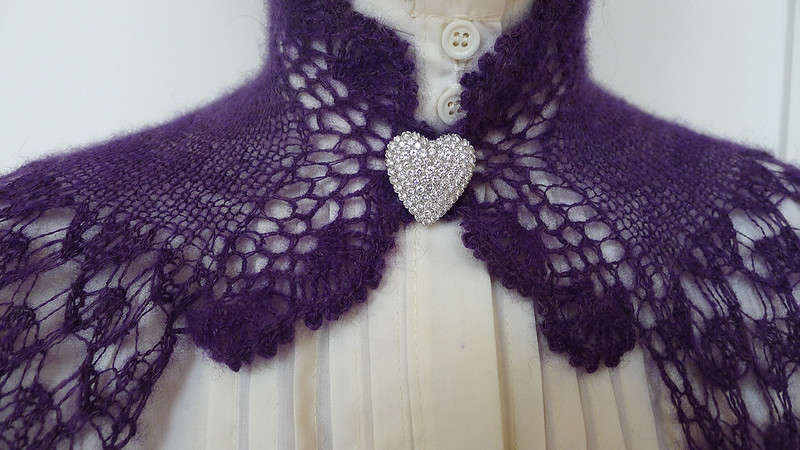
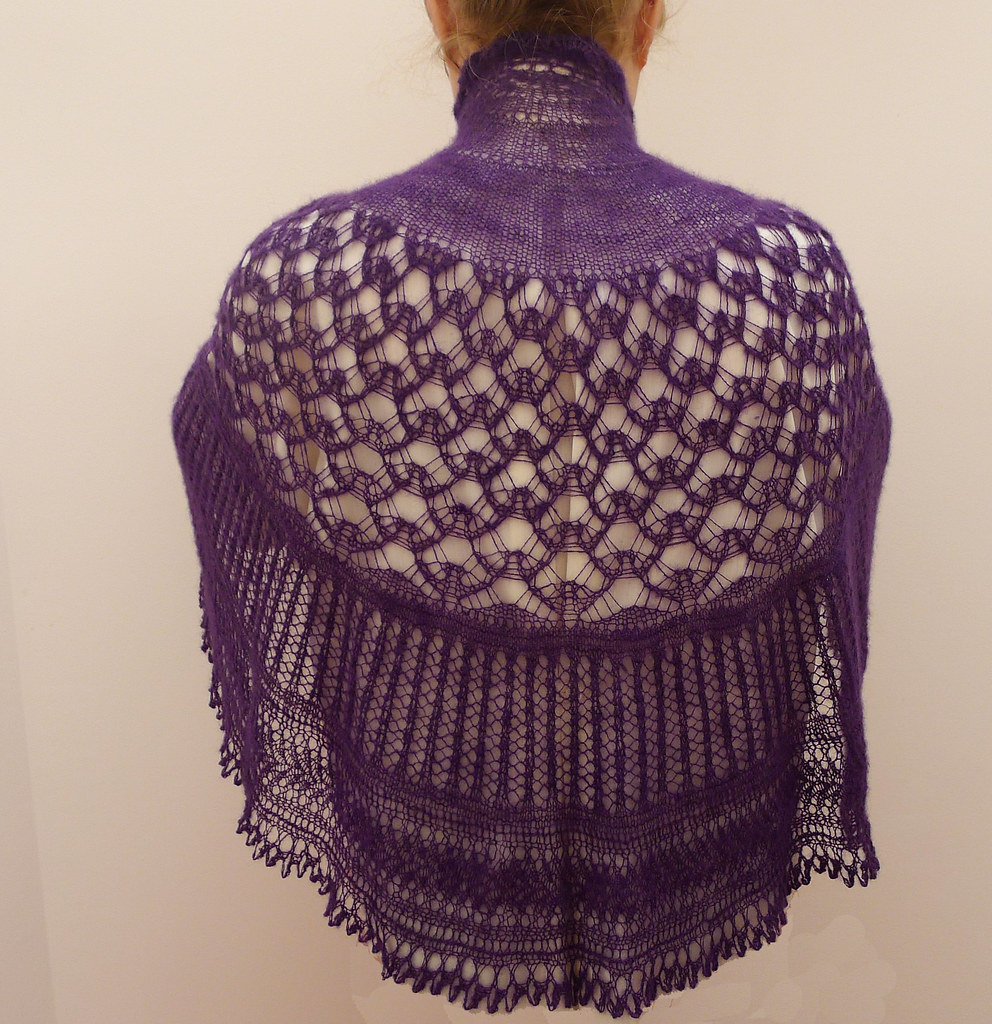
When Harry first tossed me his redesigned border for the King Bat shawl, I was skeptical. After having knit this border section, I just laughed out loud. Who else could work bats and hearts into a Shetland ring shawl? Sharon Miller should never see this. I see a hoard of peasants out there warming up their pitchforks. Not good.

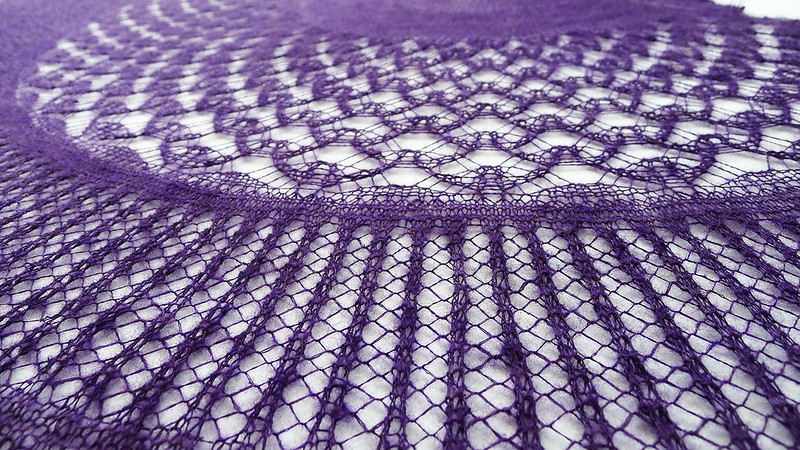
I am about 30% done with the border...from here on, except for the addition of another row of hearts, the border sort of mostly follows the original design. And I promise to be faithful to the edging, except where I might change it.


Current dilemmas revolve around whether to buy another Bosworth or veer off the well-trodden spindle path and get a Golding. I know I can't go wrong with a Bossie, but those Goldings are so lovely... I am sure there are plenty of opinions out there. Convince me.

Tuesday, June 23, 2009

The Blame Game

The blame for this post falls directly onto the shoulders of The Akamai Knitter and LaceFreak Jane. I refuse to accept any responsibility for my actions, because it's Not My Fault.

After observing (with tears in my eyes and lust in my heart) the spindle acquisitions of these two blameful beings, I was forced, much against my will, to order a 2" Karelian birch Bosworth spindle (about 18 grams) and two ounces of 80% merino, 20% cashmere from Miss Babs.


After a few false starts, due to the fact that I had never used a top whirler, I was happy to discover that spinning is like riding a bicycle. It didn't take long before I was humming along in my personal comfort zone of 80 wpi.


After a few days of spinning plain gray, my eyeballs itched for some color. A little red dye, a little fiber...


I also ordered a bit of angora/merino top from Susan's Spinning Bunny. In a remarkable display of postal schizophrenia, the package was both refused and signed for on the same day. Somehow, it was apparently refused here and returned to Susan, but when we looked up the tracking number, the post office said it was signed for and received on 6/18.

I questioned Harry closely about this, and the best explanation we have is that Harry answered the door, whereupon the mail carrier dropped her electronic gizmo, and ran screaming back to the car with the package. Harry carefully signed for the package by stomping on the gizmo's touch screen, and then wandered over to the hammock with a cold beer.

Meanwhile, after inhaling several tablets of Xanax, the postal carrier snuck back up to the front door, retrieved her gizmo, and then screeched out of the driveway with the package beside her.

If anyone has a better explanation, I would sure love to hear about it.

Wednesday, June 10, 2009

Purl Decreases Demystified

If you hunt around the Internet in search of purl decreases, you will probably encounter only two: the right-slanting single decrease (P2tog) and the right-slanting double decrease (P3tog). There may be times, however, when you need single or double left-slanting purl decreases or a double purl decrease with no slant at all.

Most commonly, you will encounter these snarky decreases if you are knitting garter-stitch lace in-the-round, for example, a borders-outward shawl in a single piece. To maintain garter stitch in the round, alternate rows must be purled (unless you are cheating and going to futz one corner so you can knit back and forth). And if you are knitting Shetland lace, there's probably no way you will escape having to work double purl decreases with no slant. Central double decreases abound in Shetland patterns.

After perusing my standard books, such as Barbara Walker's Charted Knitting Designs, and rejecting most of the solutions as kinda awkward, I fiddled around with a few different ways of accomplishing these dratted decreases. Some people hate purling through the back of stitches. Others don't find this uncomfortable. Please try all these methods and decide which one works best for you.

Left-Slanting Single Purl Decrease

The most common method is purling through the back of two stitches thusly:


the finished stitch on the purl side:


And finished stitch on the knit side:


If you hate this process, then slip two stitches, one at a time, knitwise.

first stitch slipped...


.... second stitch slipped.


Then insert the tip of the left needle through the front of these two stitches (which are now on the right needle)...


and slip them back to the left needle as a unit. Notice that the stitches have switch positions.


Purl these two stitches together.


Here's the finished stitch on the purl side:


And here's the knit side:


The second method seems easier to me for purling together two stitches when one of them is a yarnover. But sometimes I just purl through the back. Which method I choose depends a great deal on the yarn--some yarns don't like the back stitch, some don't like the slip-and-flip business. Take your pick :)


Left-Slanting Double Purl Decrease

This is just an extension of the single decrease, but with added torment. No matter which method you use, the process is awful. My favorite method, not described here in detail, is to avoid patterns that require me to do this.
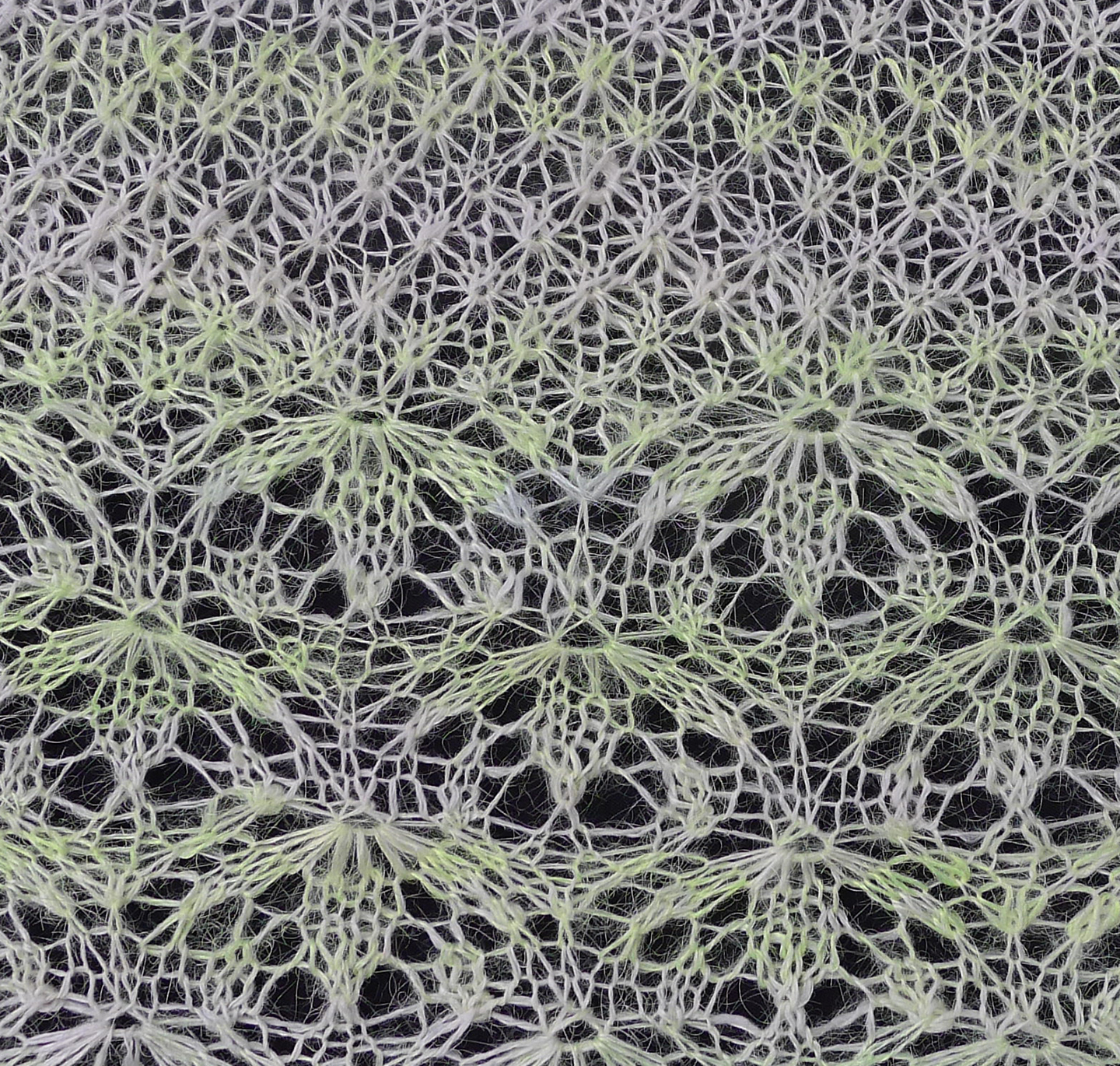
Anyway.

You can purl through the back of three stitches:


Here's what it looks like on the knit side:


Or, slip three stitches, one at a time, purlwise.


Then insert the tip of the left needle through the front of these three stitches (which are now on the right needle),


and slip them back to the left needle as a unit.


Then purl these three stitches together.


Here's the purl side:


The he knit side looks the same as knitting 3 stitches together through the back loops as shown above, so I didn't take another photo.

Yet another method is described in the Walker book. Purl two stitches together. Keeping the yarn in front, put the stitch back on the left-hand needle. Pass the next stitch over this one, then transfer to the right-hand needle. I frankly don't care for the way it looks, but it's simpler to execute.


Double-Purl Decrease with No Slant (Central Double Purl Decrease)
This one is actually pretty easy. The literature I encountered had some wacky solutions; I think my answer is simpler. The first two steps are identical to the Left-Slanting Single Purl Decrease shown above.

Slip two stitches, one at a time, knitwise.
Then insert the tip of the left needle through the front of these two stitches (which are now on the right needle), and slip them back to the left needle as a unit.

Purl three stitches together (the two you slipped and flipped, plus one on the left-hand needle).


Here's the finished decrease on the purl side:


and the knit side:

Wednesday, June 3, 2009

Queen Ring Shetland Center--Complete!

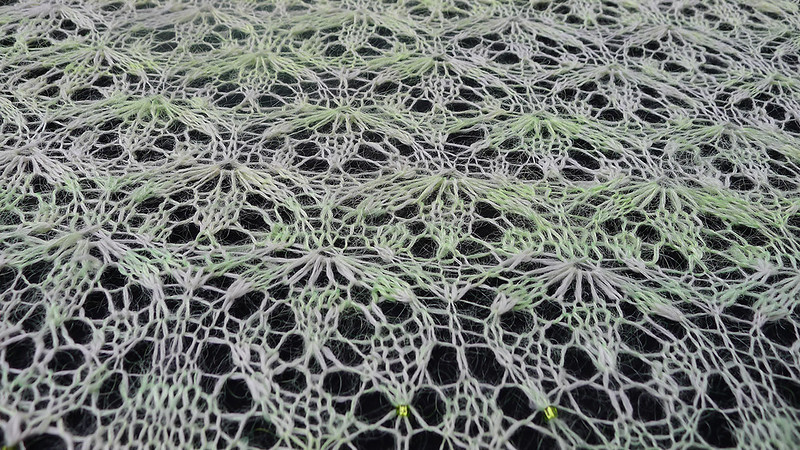
Easy and fun to knit, the center for the Queen Ring/King Bat shawl didn't take long, either. I am under no illusion that the border (or the miles of interminable edging) will dance off my needles quite as quickly , but it's still a very pleasant pattern to work.


And the yarn! Technically, it's 52/2 60% merino, 20% cashmere, 20% silk. But to knit with it--it's incredible! It's stupendous! It's incredible! Oh whoops, I said that. It's bouncy. It's silky. It's soft. It's everything a gossamer yarn is supposed to be. It deserves a niche in the Yarn Hall of Fame.

Alas, I bought the only skein in the universe on my trip to Japan last year. I was so besotted with it that I decided that I had to have more.

I sent a sample to a mill in China and asked what their minimum order was for a custom spin. The bad news was that I needed to buy 50 kilos. Much as I loved it, I didn't love it 50 kilos-worth. Each kilo has 25,000 meters, and, while I am a fairly robust knitter, I couldn't see my way to stashing 1,250,000 meters of yarn. There are limits, even for me.

I figured there were probably a few other people who might go in with me on the buy. I posted the information in the Heirloom Knitting group on Ravelry and placed a little Post-It note next to the computer to write down the names of the five or six people I figured would want a kilo or two. To my utter bafflement, I had to quickly switch to a spreadsheet to keep track of the orders.

The good news is that I have 100 kilos subscribed. In about a month, I will be able to roll around in the stuff (just kidding, guys, really!)

The thought of 200 pounds of yarn landing in my yard is a bit daunting, but a dear lady is driving down from South Carolina to help us pack and ship the 2,500,000 meters of the yarn I am naming Phoenix.

Of course, Harry said he would help out by providing the entertainment. Unfortunately, he has developed a crush on Al Jolson. The house reverberates with the clickity-click of eight little feet tap-dancing on the dining room table. I can't wait to see what he has in store for us as we wrestle with mailing bags. Hmm, perhaps he will fit in one of them. (Joke--it's a joke!) I promise that nobody will open their package and find a tap-dancing spider in it. Unless, of course, you want one.
Wednesday, May 20, 2009

Knitting Rules of Thumb

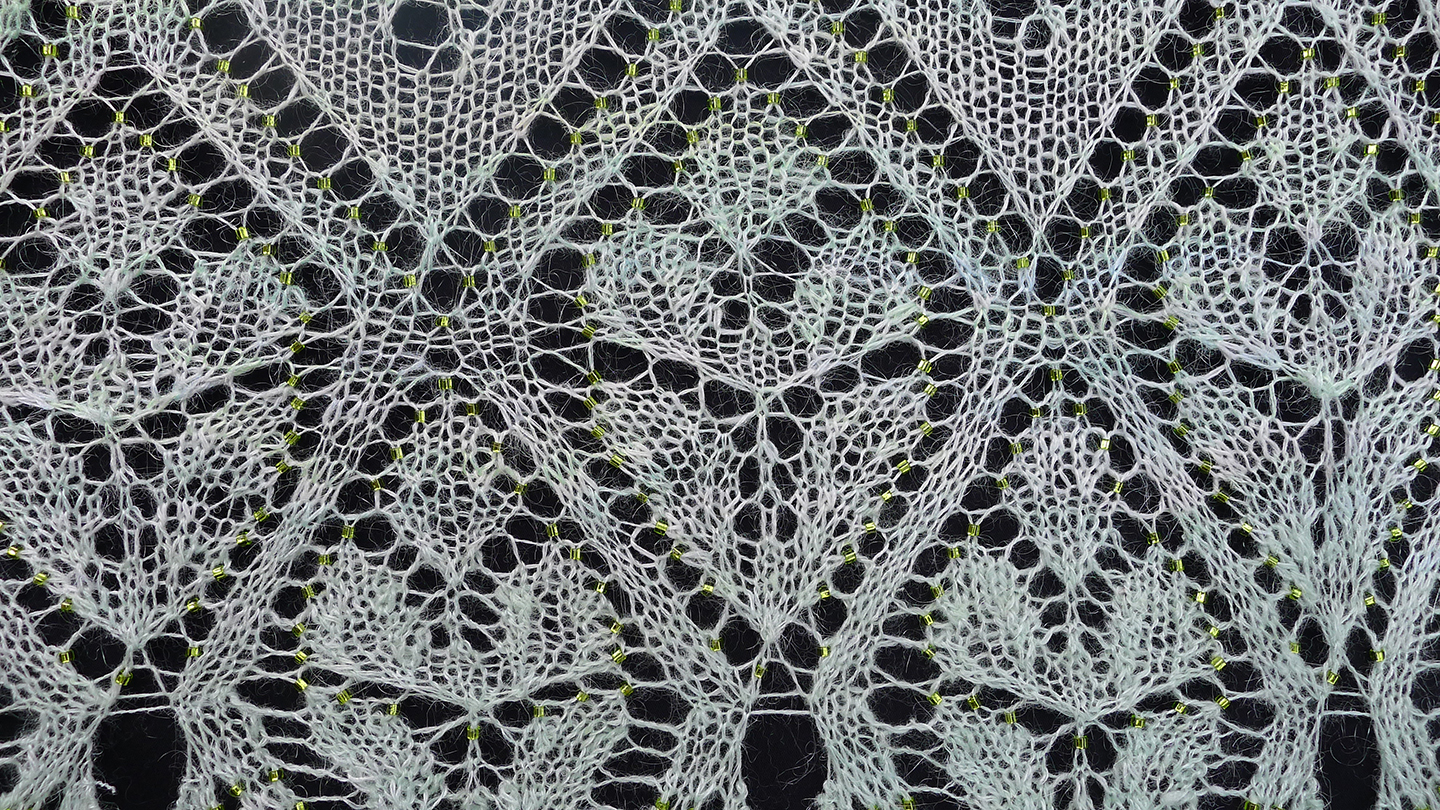
Every so often, I come across an approximation that makes sense, is easy to remember, and I actually write down in my knitting notebook under the heading Cool Things That Are Easy to Remember but I Forget Anyway. I was flicking through said notebook the other day looking for something I have already forgotten about, and stumbled across the list. Because I am feeling way too lazy to photograph the center of the King Bat (aka Queen Ring) shawl that I finished a few days ago, I figured the list entries might come in handy for some of you. And make me feel less guilty about not stretching, pinning, photographing, cropping, uploading, and so on and so on.

Please remember that these are Rules of Thumb, not Inviolate Laws of Physics. If one or the other doesn't work every time, perhaps you could arrange for a different thumb or something.

  1. If you don't know what needle size might work best with a mystery yarn, thread the yarn through your needle gauge. The best fit is a good size to start with for regular knitting. For lace, try doubling the needle size.

  2. Don't want to (or can't) measure someone's foot? The length from the tip of the index finger to the base of the thumb is about equal to the length from the toe to where the foot connects to the leg (measured at the top of the foot). I discovered this one day when I put my sock over my hand. Why did I do that? I don't know.

  3. The measurement from the base of your thumb to the inside of your elbow is the same as the total length of your foot. Seems incredible, but it's true.

  4. If you stretch out your arms and measure from fingertip to fingertip, the length is the same as your height. You might find this useful when knitting shawls (Thanks, Carla!).

  5. The circumference of your wrist is about equal to the circumference of your foot at the arch. I have never needed to know what my arch circumference is, but I am sure there's someone out there who has been panting after this fact.

  6. The sleeves of an average sweater uses 1/3 of the total amount of yarn; the back takes 1/3, and the front 1/3. If you are not sure that you have enough yarn, knit the sleeves. Then you can adjust the body by, say, making it shorter, using a different yarn for the yoke, or blending in another dye lot.

  7. A cable takes about 10% more yarn than knitting the same stitches flat. This is an important rule of thumb if you decide to add some cables to a plain sweater--you'll need to cast on extra stitches or the fit of the sweater might be a big surprise. Actually, it would be a small surprise, but you know what I mean.

  8. Changing the size of your needle will change the gauge by about 1/2 stitch per inch for each needle size increment or decrement.

  9. One row of knitting uses about 3 times its length in yarn. This is a nice factoid for long-tail cast-on that eludes me every time I do a long-tail cast-on.

  10. According to the folks at Elann, if the gauge of a single strand of yarn is X stitches-per-inch, the gauge when used doubled will be X*.7.

  11. Also via Elann--if the project requires X ounces of yarn used single-stranded, it will require X*1.4 when used doubled.

  12. If you want to make a circular shawl, the general rule for increasing, is to increase four stitches every round, eight every other round, 12 every third round, or 16 every fourth round. There's some geometric flim-flam going on here. Please don't try to explain it to me.

  13. Eight increases/decreases every second round will give you a flat knitted circle. Six increases/decreases every round in single crochet will too.

  14. If you make six increases every second round, then knit x rows (where x is the number of rows with increases that you just made) then decrease six times every other row, you will get a ball.

  15. Two increases/decreases in the center of every second row will give you a 90 degree angle. That one’s pretty obvious, but it’s so useful.

  16. The last row of a project takes as long to knit as the rest of the entire sweater/sock/hat/scarf. This is a prime example of the Time Dilation effect.
Friday, May 15, 2009

Easy Go: The Sequel

Thanks so very much to everyone who made room in their homes for last week's offerings. Harry was delighted to learn that I didn't sell the hot pink eyelash yarn. However, what I didn't mention to him was that I had cut that grisly stuff into small bits and auctioned it off to the neighborhood birds. The nests look a bit, erm, exuberant, but at least they all match.

The back yard now resembles a miniature South Florida neighborhood. One enterprising family of chickadees further adorned their home with tiny pink flamingos. (I don't want to know where these came from.) Unfortunately, the yarn clashed horribly with Mr. and Mrs. Cardinal, who finally convinced me to trade the lurid pink for some equally regrettable twinkly fun fur. Their nest looks like a Las Vegas casino, but it sure is cheerful.

This week, I am listing a few more lace yarns, but most of what's here is sock/fingering weight. My Paypal address is sglinert--feel free to send me money and I will send you your yarn. Don't forget to tell me which yarn you want in the Paypal comment section. Or you can just email me, if that's more convenient.

IST Spindle--18 grams--oak burr inlay, sycamore whorl and ash shaft.
$60 including US postage

Lisa Souza Sock Merino-Graphite
100% Superfine Merino Superwash 560 Yards
$18 including US postage


Katsara Yarn Pure Merino Fingering Sock- Hosta
100% Merino 370 yards

$12
including US postage

Katsara Yarn Pure Merino Fingering Sock- Delphi
100% Merino 370 yards

$12
including US postage


Seacoast Handpainted Superwash Sock
-Pink/Green/Beige
100% merino 560 yards
$21 including US postage

Unique Sheep Merino Sock-Blue/Purple
75% superwash merino, 25%mohair 346 yards
$17 including US postage


Claudia Handpainted Sock-Oops (2 available)
100% merino 350 yards in BOTH skeins
$21 including US postage


Greenwood Fiberworks Cotton Lycra Sock Yarn--Yellow
96% cotton, 4% Lycra 460 yards
$16 including US postage


Greenwood Fiberworks Cotton Lycra Sock Yarn--Black
96% cotton, 4% Lycra 460 yards
$16 including US postage


Greenwood Fiberworks Cotton Lycra Sock Yarn--Green
96% cotton, 4% Lycra 460 yards
$16 including US postage


Thursday, May 7, 2009

Easy Come, Easy Go

Well, it was certainly an eventful day. With no notice whatsoever, my company shut its doors. Worse, it shut its doors owing me a lot on money. I was also bemused to see my name spelled incorrectly on the severance letter, which sternly admonished me to refrain from discussing anything about this incident with anyone, including family pets, houseplants, or myself.

On the bright side, Harry offered to contribute to the household income by accepting a karaoke gig in Bulgaria. He then threw himself into a bottle of sake, where he has remained for most of the afternoon.

While he is in his state of inebriation, I was able to get into my stash again and sort through it.


As is often the case with stash, I found quite a lot of it that I will never use. I want to say that no offer is too small to be refused, but that's not the case. However, if you have a reasonable bid for the lace yarns listed below, I sure would like to hear it.

Katsara Yarns Alpaca Fingering--Coleus (two skeins available)
1000 yards, $38 per skein, including US postage


I shall post sock and miscellaneous other yarns for sale next week. Harry is now sleeping off his sake binge on the sock stash and I don't want to disturb him.

Wednesday, May 6, 2009

Why Knot?

I love the Internet. While lounging around in my ratty shorts and t-shirt, I can go anywhere and discover just about anything except how to get rid of giant spiders that steal my stash, hoard my needles, and filch my patterns Harry. During one of my epic wanders, I stumbled upon a truly cool site called clanbadge.com.

Daniel sells a font that charts Celtic knots. I cannot imagine how many hours went into the design, but the results are simply amazing. The site is a bit confusing, so here is the link to the Charted font.

For example, by typing the following into Microsoft Word:

qe
zc


And then applying his font, I get the following little design:


Well, that might be interesting to cross-stitchers, but maybe not so interesting to knitters. That is, until I apply some knitting symbols to the design.

Naturally, the first thing I thought of was lace. There are several ways to treat the motif. It can be outlined with yarnovers thusly:


Or the interior can be filled with a small pattern:


Of course, these designs can be knitted without any holes at all. Cable lovers can go insane knitting something like this:


For those who like colorwork, a bit of paint to the following would make an interesting (and confusing) sweater motif.


If you want to purchase the font for charting, make sure you buy the Charting font. Daniel also offers several other fonts, for example outline, 3D, and inverse, and filled. This page shows some beautiful examples of Celtic knots applied to a variety of crafts such as woodworking, quilting, metalsmithing, stained glass, and ostrich egg carving. Daniel offers a pattern pack for the chart font and there's a page of fancy knots that users have posted, which you can find here.

I would love to continue this post, but unfortunately, Harry just pulled the plug out of the compu

Wednesday, April 29, 2009

How To Go Off On a Tangent

The other day, in search of Something Different, I plucked Galina Khmeleva's lovely book--Gossamer Webs--off my bookshelf and refreshed my memory of Orenburg shawls.


These extremely fine shawls have been traditionally knit by ladies in and around Orenburg, Russia. The designs are quite geometric and the construction unique and efficient. The traditional yarn--goat down plied with thin single-ply silk--is handspun on lightweight supported spindles.

Unlike Shetland shawl knitting, which is popular enough to support commercially available yarn and a wealth of patterns, genuine Orenburg yarn cannot be purchased and charted designs are basically limited to those in Galina's books. In fact, Ravelry's knitqueen05 has knitted most of Galina's patterns--over and over and over. Yike!

I am intrigued by the fineness of the spinning and the luxurious feel of these shawls (I got to fondle them at the Skaska booth at Stitches South). I am intrigued enough to actually think about spinning again. (Opal, I don't want to hear about it.)

The thought made my brain cramp--I was shearing sheep and spinning before most of you were even born. My flock of rare non-white sheep and the byproducts thereof put me through graduate school.

I can't say that I enjoyed spinning. I recall with a grimace the lady who brought me Samoyed dog combings every year so I could spin sweater yarn for her. No matter how carefully or with what I washed the yarn, it retained its appalling dog odor and had to be dried as far from my house as possible. Worse, my cats hated the stuff and I had to leave it hanging in the barn lest it get clawed back into fluff again.

However, I did win several blue ribbons at the state fair for my fine skeins of lace yarns (90 wpi!), so the thought of spinning yarn for an Orenburg doesn't make me faint.

Times have changed since the 60's, when only a few types of wheels were available for purchase. As I wandered around the Internet spinning sites, I chanced upon the perfect solution for whipping out fine yarns without straining the shoulder or knee.

Warning!! All you spinners out there are about to toss rotten tomatoes at your screen. Spinning snobs should exit now!!!

Look: an electric charkha!


Fetchingly made from PVC pipe, a wheelchair wheel, and a knitting needle, Babe's Electric Liten Spindle Charkha Wheel entranced me. It weighs only two pounds and disassembles into a small box of giblets for compact storage. It's made for spinning gossamer-weight yarns and the motor assures a nice even pace for drafting.

I haven't quite justified the cost to myself yet. I may decide that the entire concept is too much trouble and just use some gossamer-weight cashmere to knit an Orenburg. On the other hand, new horizons beckon. I wouldn't want to get bored, now would I?

Harry, of course, thinks the concept is wonderful. At last he will have someone who can repair his disgraceful web. "Male spiders may knit, but they don't waste their time producing spider silk," he sniffed. "And cashmere batt will make an excellent mattress."

Sunday, April 19, 2009

Going Bats

A well-written pattern is akin to a gripping novel--tightly plotted and suspenseful, and a satisfying denouement with all the loose ends tidily wrapped up. A poorly written pattern, on the other hand, reminds me of a badly produced movie--terrible acting, disjointed, confusing plot, and loose ends galore at the end.

Occasionally, I will run across a pattern that makes me snicker. For example, any production with the line "Reserve at least 10 hours for sewing together" is, by definition, a genuine howler.

When I encountered this particular direction in the Queen Ring shawl, I giggled for at least ten minutes.

The original shawl is knitted from the borders inward. I don't like that construction for a number of reasons, not the least of which is the epic sewing-bits-together at the end. I wouldn't mind the sewing so much if it produced an attractive finished product. It doesn't. Sewn-together seams look ugly and I won't use them.

The second problem with the original pattern is that only half of the border is neatly mitered around the center's corners. The other two sides are stretched into shape during blocking. The stretching might work if the shawl is knitted with a nice, compliant wool yarn. It probably won't work with something like cashmere/silk yarn, which has the elasticity of a watermelon. The fact that the corners in the lovely photo are scrunched together and not viewable makes me uneasy. I want fully mitered corners that won't produce an unpleasant surprise after hundreds of hours of intense knitting.

Thus, I regraphed the shawl to be knit from the center outward, which means the border is picked up around the center square and knitted around and around (and around and around and etc. etc., and so forth....).

This process has its own inherent problems. First, the border itself must be inverted, because it's being knitted from top to bottom instead of bottom to top. Anyone who has ever reversed a pattern knows that it's usually impossible to simply turn it upside-down. And then there is the tedium of having to purl every other round in pattern to maintain the garter stitch in circular knitting mode. I tried a number of different fake corners to avoid the purling, but didn't care for the results.

Unfortunately, at some point during this epic graphing production, I took a well-deserved break. When I returned to the computer, Harry had redesigned the shawl border to suit his bizarre awful regrettable erm, unique taste. He had lopped off the seed pods (a decision I applauded) and substituted the never-before-revealed Shetland motif: Flying Bats.


Harry announced that he just adores bats. I was a bit puzzled when he uttered that statement, because airborne insect-devouring predators just didn't strike me as arachnid-friendly. However, Harry pointed out that bats make exceptional targets and he enjoys plinking at them with his custom-built Barrett Model 82A1 .50 caliber sniper rifle (with BORS optics).

I also took issue with his introduction of non-traditional motifs into a mostly traditional Shetland shawl. I have this uneasy feeling that, after having worked his bats into the shawl border, I will open the door and find a mob of enraged Shetland Islanders bearing torches and brandishing pitchforks. But Harry pointed out that our designs often begin with a healthy respect for tradition and end up, well, different than the original pattern.

So, here's a bit of eye candy for you. It's one repeat of the center. The shawl is being worked in a 52/2 yarn composed of 60% wool, 20% cashmere, 20% silk that I purchased at Avril and dyed myself. Alas, there is no more of it, which is a real loss to the lace-knitting community. It's a lovely knit.

Sunday, April 5, 2009

Irtfa Irt'fa Irt'faa Irt'fa Irtfa'a...Oh, heck, dark purple Faroese shawl

My mother, who could out-curse any five drunken sailors, was (incredibly) an English major at NYU. I was therefore subjected to considerable cruel and unusual punishment during my formative years. From age 7, I was tasked with solving the New York Times crossword puzzle every morning before I left for school. Worse, when I achieved the lofty status of a tenth-grader, I was required to work it out using a pen.

I finally rebelled when she dragged out the typewriter sometime during my senior year. I think she was desperately trying to train me up so I could beat the socks off my Uncle Stanley, who could actually work the London Times crossword with a typewriter, a feat even my mother couldn't match.

The result of all this brain-twisting was that a) I knew more obscure words than my teachers and b) I was a whiz at spelling. At least I was a whiz at spelling before I encountered this shawl.


An Ann Hanson Faroese-style design, the final product is indeed lovely and doesn't slide off the shoulders, thanks to the top shaping. The knitting, alas, got a bit tedious.


I designate patterns of this type as "Beer-Bottle Shawls." Wait--it's not what you're thinking! I am referring, of course, to the repeat accumulation. One repeat on the needles, two repeats on the needles, three repeats on the needles....100 bottles of beer on the wall etc. blah.

By the time I have worked five repeats, I start looking for tax forms to fill out in lieu of knitting another row of The Same Thing Over And Over. After 10 repeats, I avert my eyes when I walk by the WIP's little plastic bag. But, after a few weeks of avoidance behavior, I generally sit down, plug into some music, and finish it off.


It was a simple knit and I adored the feathery edging. The real joy of the shawl was the yarn: 2/16 Lamoramere Fine Lace Blend (50% Cormo Lambwool, 40% Angora, 10% Cashmere), from Running Wild Farms. It's soft, lofty, springy, has a very fine halo, and dyes beautifully. I bought a skein of white and hand-painted it in dark blues and purples.


I did modify the edging pattern by knitting all the stitches in both directions. Life is too short to do all the purling acrobatics required as written.

Thursday, March 26, 2009

Odds and Ends

A Cure for Knitting Ennui
A few days ago I was flipping through my pattern collection in search of Something Different. At last count, I've been knitting for 58 years (urk!), which means I am abysmally jaded. The old saying "What Goes Around Comes Around" certainly applies. The same sweaters/hats/scarves/dishcloths/tippets have gone around and come around so often that I can point to a picture and recall at least five previous incarnations.

I was grazing through this season's knitting magazine offerings and for the first time I can remember, I bought neither Interweave Knits nor Vogue Knitting. The offerings in the former were tired and the projects in the latter made me laugh.

Fortunately, I have a dear friend in England (Thanks, Jo!) who faithfully traipses to her news agent every month and ships me a lovely package of Across-the-Pond knitting magazines. Although Simply Knitting is for the beginner/intermediate knitter, every issue carries an Alan Dart toy pattern, and I dearly love these. I couldn't resist this one:


It went right to the head of the queue. The yarn is sitting in front of me waiting for me to finish this blog post.

Some brilliant English publishers thoroughly perused American knitting magazines and decided that they could do it better. And they certainly did! My last two care packages included an issue of a brand-new offering entitled The Knitter.


A few sample photos:


Intended for the experienced and adventurous, the two first glossy issues have been inspiring and beautifully laid out--treasures of knitterly eye candy. The only problem with it is that the magazine is not yet available in the US. I hope the publishers will consider overseas distribution, because advanced knitters here will surely snap up every issue. It's apparently available at bookstores and yarn shops in the US and Australia, so go get a copy!

Pattern Obscura
There's a wonderful thread on Ravelry entitled Favorite Obscure Patterns--I cruise through it often (Warning! Big Time Sucker!). Thanks to the diligence of the posters, I've added an embarrassment of items to my queue. The Internet also offers zillions of patterns that never seem to rise to public acclaim, and I want to tweet my kazoo about two of my recent favorites.

The first one is a lace shawl called Something Wicked Comes This Way, designed by Karen Walker. It's stunning! It's unusual! You can purchase it here. Go ahead--you know you want to!


--Photo Courtesy of No Two Snowflakes/Karen Walker (Thanks!)

The second pattern comes from the famous White Lies Designs. However, I haven't seen anyone get excited about this pattern...
....but I think it's eyepopping. And I have sufficient Yubina worsted-weight cashmere to make it. I have asked Harry dye the yarn for me in the requisite luscious shade of crimson, and he's agreed to do it in exchange for our new car and a year's supply of chocolate-covered beetles. A fair trade for him.

Yarn Obscura
Artist's Palette Yarn is one of my favorite Internet stores. Yes yes, she's in England. but the postage isn't punishing and the yarn will make you weep with delight. I've purchased a variety of her offerings--the quality is superb and the dying exquisite. Do give her store a try if you are looking for a little treat. Here are a few of her many types of yarns.

Glisten is a luxurious 2-ply 100% silk yarn, soft as down. I actually bought all four skeins--1200 yards will make a lovely shawl. Sorry, folks.


Damsel is 80% Extra Fine Merino 20% Silk cobweb weight, with 1200 yards per skein. She's currently having a 20% off sale. Don't you hate it when I tell you things like this?


And finally, I want to also report that I have also fallen in love with the yarns from No Two Snowflakes. Her stock isn't extensive and goes quickly, so you'll have to regularly troll her Etsy shop and see what's available. I snagged a skein of Roses and Lilacs cobweb-weight silk:


...and two skeins of Juicy Nectarine cobweb weight 50% silk, 50% wool.


Have fun grazing!

Sunday, March 1, 2009

Iris

I have to admit that I started Susan Pandorf's Iris stole with more than a little trepidation. The skeins of Handmaiden Seasilk (Mermaid colorway) looked unpleasantly brown to me and I wondered if the final result would be at all similar to her sample. The answer is yes--and it's quite stunning in person. Alas, the photos can't convey the beauteous shimmering of the silk or the glitter of the lovely beads.


This is not a project for the impatient. There are LOTS of beads in this stole. Worse, the Seasilk is quite heavy and the #8 beads quite tiny. Most of the crochet hooks I tried could not pull the entire yarn through the bead hole.

The first few hooks I tried grabbed only a few plies of the yarn, producing a sort of shredded furry carpet of Seasilk (not quite the effect I was looking for). I finally dug out my mother's Really Old Boye #12, and that hook worked perfectly, although considerable force is required to yank the yarn through the little bead holes).

I compared my set of hooks to my mother's and discovered that hers have a much deeper hook than my newer Boyes. I immediately took myself off to eBay and found an identical backup hook in case the first one broke.


I have several other projects of Susan Pandorf's in the queue, most of which use the same yarn/bead combination. For the next one though, I ordered Delica beads, which have larger holes than the seed beads I used for Iris. The Delicas slide easily onto the Seasilk without a pitched battle.

I am about 3/4's finished with the first half, so this stole won't be completed for a while. Once you get past the intriguing triangular area shown below, the pattern becomes repetitive (and not terribly interesting to knit).


I figure it will be finished around the time it becomes too hot to wear it.


Sunday, February 8, 2009

Pearly Whites

The weather is lovely here in Costa Rica, but apparently, it's a bit nippy back in the US and other Northern climes. So, despite the fact that we are prancing around in shorts, many of you may appreciate seeing (and knitting) a Really Warm Hat.


The pattern is Susan Pandorf's Gotham hat, which I modified because I used heavier yarn than the original. I happened to have some Yubina Chunky cashmere and a bit of Richmore Count 10 mohair, so I worked them together to make a fluffy, warm little head cover. I omitted the final repeat and altered the stitch count to make the hat fit my head (a practical concept I try to use often).

I wanted to decorate the hat with some beady stuff, but I didn't want pounds of pearls on my head, so I bought some cheap plastic pearls from Michaels and sewed them on afterward. The holes in the pearls were too small to thread on the yarn during construction.

In Other News...

We originally came down to Costa Rica for a bit of medical work and a lot of sightseeing, but our trip didn't work out exactly as planned (as usual). Instead of frolicking in the rain forests and ogling indigenous animal life, I spent most of it in a San Jose hospital.

I can tell you that, while the hospital was fabulous (and accepts Blue Cross/Blue Shield), I was unable to knit, thanks to the plentiful IVs that adorned both arms. In fact, even though I couldn't do anything with knitting needles (Enough already with the needles!), I did sort of resemble of skein of yarn. The knitless weeks turned out to be a good thing, because I was down to a single skein of sock yarn. And folks, there is not a single yarn store in the entire country.

Several lovely people offered to send me yarn--thank you all for your generosity!

We are returning home Wednesday where I shall bury my face in my stash for a few hours and pick up my needles (knitting, not IV) once more. I do have something exquisitely lovely to show you next time, so please come back and enjoy.

And no, before you ask, Harry was totally useless. He picked up a karaoke gig in a local bar, where his Japanese renditions of popular favorites were greeted with wild enthusiasm. He did visit the hospital several times, only to be chased around by nurses wielding tightly wrapped tortillas. He also took my lonely skein of sock yarn with him on his last visit, noting that I couldn't knit, so why waste it? Little heartless creep.

Sunday, January 11, 2009

Triads


Well, there are certainly a lot of traids here! it was an interesting knit, although I do not want to see another triad for a while, after plodding through 24 repeats. I did, however, have an engaging time with the dangly balls I knit into the edging. The added weight on the ends makes the scarf stay in place instead of fluttering and flooping around.

Particulars:
Pattern:Triad by Susan Pandorf
Yarn:Handmaiden Fine Yarn Lace Silk in Rainforest (used about 250 yards)

Needle Size: #4
Beads: Stuff I bought them at Michael's. No useful labels on the packaging, I'm sorry to say.

Speaking of rain forests, we are in Costa Rica for a month. The Internet is a bit shaky, so if I don't send you comments, please forgive me (and the Costa Rican ISP).

Sunday, January 4, 2009

Fishing for Compliments

I don't care for felting and have a healthy horror of large needles, but I overcame both aversions recently after falling in love with this sweet little confection:


It sort of came as a kit at my LYS, but I ended up changing the yarn color from orange to black, so I did not walk out with the pretty bag that held the original package.

Because the pattern was fraught with errors and omissions, I won't mention the designer's name here. (I am beginning to think that every time I pick up a pattern, it immediately shifts to Errata Mode). Here's a sample from the purse pattern:

Knit 4 stitches; bring yarn forward between needle tips (BYF).
Knit 15 stitches, BYF.

Wait! The yarn is already in the front! Rip.

I finally worked the purse thusly:

Toss pattern in the trash and *make up the pattern so it looks like the store sample.*
Repeat from * to *.

Knitted with doubled Malabrigo worsted on size 13 needles, the purse was agony to finish. Needles that large should be illegal, or at least should have a Carpal Tunnel/Knitter's Elbow warning prominently stamped on the shaft. There was a lot of i-cord, too, but I refused to purchase a set of #13 dpns that I would never use again, so I used my Boye NeedleMasters with 16" cables. They weigh a ton. Never again.

A Side Note: A few weeks ago I watched a 13-year-old struggle with size 15 needles. She was clearly hating every stitch. It should also be illegal to give children needles larger than, say, a size 6. You are never too young to wreak havoc on your tendons, carpals, and other delicate body parts.

Where was I? Oh yes. Fish purse. The handle was made with 84 interminable inches of i-cord. I discovered that, instead of dropping the yarn, sliding the stitches to the other end of the needle, and picking up the yarn again, it was easier to just slip the three stitches back to the left-hand needle after knitting them. I started picking up speed at that point, but it seemed like I would never finish.

I bought the fish and yarn from Twisted Skeins. The shop doesn't have an Internet store yet, but you can probably call her and order fish-by-the-yard over the phone. I don't recommend purchasing the pattern--just find your own felted bag directions and go fishing!

Wednesday, December 31, 2008

Adding Insult to Injury

The Original Stash Configuration:


The injury:


The insult:


The response:


Have a wonderful New Year, everyone!

Thursday, December 25, 2008

A Handmaiden's Christmas Tale

Santa was clearly not paying attention to the gloomy economy prognostications when he visited chez fleegle this year.

Having fallen in love with Susan Pandorf's magnificent designs, Roy took it upon himself to order the yarn required to complete three of her shawls. And then he added some more stuff for emergencies because he's a prince, **supreme panjandrum** of a husband.

Handmaiden Seasilk in Mermaid, for the Iris Scarf:


Handmaiden Seasilk in Poinsettia, for the Poinsettia scarf:


Handmaiden Seasilk in Pale Autumn, for the Zinnia scarf:


And a few non-assigned skeins of Seasilk.

Pumpkin:


Blackberry:


Fleur:

Renaissance:


Some Jojoland Melody for lace:


An exquisite skein of Art Yarns Beaded Silk Rhapsody:


And, just in case I get overwhelmed with complex lace beading, a simple shawl kit from Colinette:


And finally, to keep me warm while I am playing with all this lovely stash, a cashmere bathrobe:


Harry watched the unwrapping process with a furtive, avaricious look in his eyes. He became profoundly depressed when he saw that, along with the stash enhancement, came some first-class SWAT-designed stash protection. Sitting proudly atop the chain-locked, police-taped plastic box, is a spray can of BUG REPELLENT! Merry Christmas, Harry!


I hope you all enjoyed your holiday as much as I did!

Monday, December 15, 2008

Pearly Blues

Disaster struck the fleegle household this week. Harry pranced in the door a few days ago with an iPod Nano that he won cheating in a poker game. He then spent two days downloading the lyrics to his tunes--an ominous portent of things to come.

With astounding proficiency, he proceeded to jack the iPod into a pair of speakers only slightly smaller than Toad Suck, Arkansas. And in a final display of arachnid ingenuity, he added some tiny wheels to the Nano, turning it into the world's first MP3 skateboard.

The next day, our nearest neighbor (who lives a half a mile north of us) called the police, complaining that a brain-melting version of Irene Cara's Fame was blasting out of her poinsettia.

Fortunately, Roy and I had invested in sound-suppressing earphones minutes after we were introduced to Harry's karaoke machine. We never heard (a) the police hammering on our door or (b) the high-pitched yelps as they fled from the vision of a ten-inch break-dancing spider draped in Red Roxx earbuds, caroming around the dining room on a purple iPod.

And anyway, I was too busy finishing this sweater to bother about the noise.


The design is loosely based on the Feather and Fan Sweater in Gathering of Lace. The original reminded me pleasantly of a raspberry sundae, but I am past the days of wearing ice cream, so the first thing I changed were the colors. I didn't care for the shapeless bottom hemline, so I added a neat twisted ribbing. The sleeves of the original were way too long and wide for someone who cooks on a gas stove, so the shape was streamlined. And during the cuff redesign, some pearl beads wandered in.


By this time, I was having too much fun deviating from the original, so the feather and fan pattern itself was modified (didn't care for the purl ridges) and more beads were added around the neckline. Having been knitted with Blue Sky alpaca/silk. it's a luxuriously soft and warm confection.

Monday, December 1, 2008

Small Bits

I am still somewhat clobbered by whatever I caught last month, so my knitting has been unusually sporadic. I did start the Dragon of Happiness shawl with some hand-dyed Fino, but decided that I really dislike knitting Fino on #1 needles--the resultant fabric is stiff and weirdly hairy.


I ordered some brilliant red Colourmart cashmere/lurex and will try again when I am feeling better. Or not. Somehow, the design isn't calling to me at present.

In search of something different, I happened upon Susan Pandorf's lyrically gorgeous designs and purchased five of them. Despite my dizziness and chronic cough, I managed to cast on and knit a bit of Triad:


As you can see, I added little gold beads to this design, which is being worked with Handmaiden Lace Silk in the Rainforest colorway. The formation of the trefoils is especially interesting, requiring cast-on's in the middle of purl rows and other challenges to eye-hand coordination. I did figure out how to avoid turning the work around to do the cast-ons, which in my physical state, is no mean feat.


Stitches South!
Finally! A Stitches event near me! I signed up for only one class--Fiendishly Difficult Stitches with Merike Saarniit, but I hope to meet up with friends on Friday. Anybody coming? Let me know!

Saturday, November 22, 2008

Ninjin: The Killer Rabbit

Fleegle is out sick again this week--felled by a nasty broccoli bronchial infection. Fortunately for my faithful readers, I don't have any broccoli bronchi, so I offered to fill in. I am so thoughtful, considerate, brave, trustworthy, loyal, friendly courteous, helpful, friendly, kind, obedient, cheerful, thrifty, brave, clean and reverent!

I've been resting on my laurels since my last fantastic creation (Lavori #5, page 14)... well, actually, I've been resting on my waterbed...but you get the idea that I am resting.

Anyway, since fleegle is currently incapable of decided which part of a dpn is the working end, I thought I would introduce you to the newest member of the household:


As you can see, Ninjin (carrots, in Japanese) is fairly fearsome. The other day I pointed him at a fruit fly in the kitchen and the next thing you know, he cuddled the buzzy little irritant to death. Ninjin will be on his way to Japan soon, where he will become the Chief Enforcer in Tonya-san's household.

Bon Voyage, Ninjin!*

And folks, keep those cards and letters coming!

*This pattern can be found on page 8 of Ondori Organic Cotton Knitting, ISBN 978-4-277-17190-8. I think it's out of print, because I can't find it anywhere. The yarn used was Classic Elite Yarns Premiere, one skein of lavender with bits of purple and orange for the eyes, nose, and tail.

Thursday, November 6, 2008

Poor Little No-Name

Harry danced in the door the other day, his propeller beanie twirling madly and a smirk on his face. He tossed his new masterpiece onto my lap, instructing me to post the photos and heap on some praise for his knitting, creativity, and utterly magnetic personality.

While I am obeying his first order, I shall leave the praise to the readers of this blog. Until he returns the skein of cashmere/alpaca/silk snatched from my hands before I had even finished unwrapping it, I refuse to say anything nice about him, his knitting, or his magnetically repelling personality.

Flipping though his raspberry smoothie-spattered notes, I see that this design is called Copritavolo (tablecloth) and appears on page 14 Lavori Artistici a Calza #5. Harry used #4 needles and the carefully hoarded Vermilion Malabrigo lace yarn that I had forbidden him to touch.

The directions called for doubling the outer leaves in alternate sections, but Harry doubled them in all the repeats--he says it makes the design looks more fluid and, much as I hate to be seen agreeing with him, I think he definitely has a point.

The piece is reminiscent of the swoon-worthy Lyra, but with less mesh and plain stockinette flowers instead of twisted stitches. It's a speedy knit, actually--he finished the 140 row-pattern in a little over two weeks. Of course, he does have eight arms...

Harry must have adored the Malabrigo lace yarn, seeing as how an order form order for 100 skeins of the stuff in various colors is clipped to the front of his notes. Oh wait! Here's a match! Here's a pile of ashes that used to be an order form! Here's a spider web coated with order-form ashes! And here's a Really Annoyed Giant Spider waving eight lethally sharp objects!

I guess I shall post the remaining photos and leave him to sulk, surrounded by Ninja Stars, RPG, and flamethrower.


Saturday, November 1, 2008

A Letter From Finland

I confess that, up until recently, I rarely thought about Finland. If I did think about Finland, it was usually because I was thinking about Kyrgyzstan, a country with an overwhelming and catastrophic vowel drought. Every time I ran across a reference to Kyrgyzstan, I would invariably think how useful it would be if Kyrgyzstan would indulge in some aggressive phonetic exchange with a consonant-challenged country such as Ethiopia, Estonia, or Finland. Kyrgyzstan could unload it's overabundance of consonants and Finland (or Ethiopia or Estonia) could trade down its vowel surplus--a clear win/win for everyone, most especially anyone who has trouble pronouncing things like Kyrgyz* and "Puhuuko kukaan täällä englantia?".**

Thanks to Ravelry, Finland has been much in my thoughts this last week, as I have been exchanging emails with a lovely knitter in Finland named
Marjut (whose website is here). At one point, I idly asked her about the State of Knitting in her country. To my delight, she sent back a thoughtful, insightful, and fascinating essay, which I thought I would share with you guys.

NOTE: If you start clicking on the links in the article, please do NOT blame me if you suddenly need postage rates from Finland. It's her fault, not mine. No! Hers!

From:
Marjut


I’m lucky to live in Espoo, the second biggest city right next to our capital Helsinki. I have a lot of possibilities when it comes to yarn shopping as there are many yarn shops around. Not all the people in Finland have yarn shops this close but there are more and more great online shops.

I think the yarn shop business can be divided into three categories.

First, there are the shops I could call dinosaurs in a respectful way, the brick and mortar shops that have been around for ages. It does not matter whether knitting is trendy or not because they have enough regular customers to keep the business alive. They usually sell good reliable yarns from good reliable brands, some domestic but mostly imported ones. I’d guess the yarns are mostly Nordic or European. They’re mostly made of wool, cotton, alpaca and other natural fibres or they’re at least blends, very rarely they’re 100% acrylic. To mention just a few brands, the first ones that come to my mind are Garnstudio, Gjestal, Istex, Grignasco and Schoeller & Stahl.

The shops might also carry something fancy and trendy from eyelash yarns to other novelty yarns and luxury yarns such as cashmere and silk (blends). If the public demands and the yarn shops get good deals, they may also add new brands, like Rowan, to their selection.

The shopkeepers usually know a lot and have gained a lot of experience throughout the years. They might even have the next generation working in the shop now.

While some of the dinosaurs don’t even have web sites, some of them have moved on. They’ve started selling Debbie Bliss, Colinette and Noro and yarns made of exotic fibres like milk and soy as well and they have online stores.

Secondly, there is the Internet generation, the young women who know foreign online yarn shops and the different lovely yarns from abroad. They realised that no one is importing those yarns to Finland so they decided to do it themselves and during the last year or two they have opened many online shops. They don’t always have brick and mortar shops (some do and some don’t), but they do go to fairs or such events so you can go and fondle the yarns. They sell luxurious sock and scarf yarns, SWTC, ShibuiKnits, Malabrigo and many American yarns and bring on the new yarns as soon as they can.

They also like to cooperate with the Finnish online knitting magazine Ulla which I appreciate very much, being one of the founders and the editor in chief. Ulla is the Finnish equivalent of Knitty, made by Finnish knitters for Finnish knitters. The first issue was published in 2004.

Thirdly, we have Novita, formerly known as the Helsingin villakehräämö (Helsinki wool spinnery). Novita practically dominates the Finnish market, you can get the yarns from every supermarket that sells yarn and their most famous yarn 7 Veljestä (7 brothers, named after a famous Finnish book by Aleksis Kivi) is even on the Ravelry top 100 list.

Novita is both loved and hated. People say that the quality of the wool blend yarns has gone down during the last years and that the new yarns are mostly plastic and have too few or terrible colours. I think it’s at least partially true. Novita does have nice cotton yarns, though. It’s also true that if you want an inexpensive working horse yarn you an always go and buy Novita. They do not have much of a colour selection or the yarns look like someone used all the crayons in the box to colour it, but the yarn is easy to get. I think people partly complain because they feel let down due to the quality issues and partly for the reason a friend one explained once. She told her husband: “Darling, I nag because I want you to change your bad habits. I want to be with you and not change you to another man.”

Novita has recently launched three new luxury yarns, an eco(ish) wool yarn Stone, a wool and silk blend Wind and a wool and bamboo blend Cloud. That’s really an improvement.

Then, of course, there are small spinneries, such as Pirtin kehräämö and Ylistaron kehräämö that buy wool from the local sheep farmers and spin their own wool yarns. You can also send your own wool there to be spun.

I almost forgot Wetterhoff and Vuorelma, two corner stones of the Finnish yarn business. Wetterhoff was founded by Fredrika Wetterhoff as a handicrafts school in 1885. It is still a school and much more. In the shop they sell yarns for knitting, weaving and other handicrafts. Vuorelma was founded by Helmi Vuorelma about 100 years ago and they also sell yarns for knitting, weaving and other crafts as well as the Finnish national costumes or supplies for making them yourself.

There are also some really cool indie dyers. First there was the Kool-Aid frenzy after which people moved on to acid and reactive dyes and some started selling their hand-dyed yarns. We have Ilu, who sells Handu yarns. We have Villa Mokka who sells Mokkasukka sock yarns in her yarn shop, you can see the recent colours in her blog. We have Juuli who recently opened an online store Naurava Lammas (The Laughing Sheep) and sells fibres for spinners also. We have Utuna with an ecological touch, the owner has her yarn spun and dyes it herself. There’s also Tuulia who lives in the USA, designs knitwear, spins and dyes yarn and who has a small Etsy shop. The indie business is small but very much admired among the Internet-savvy knitters and knitbloggers and I probably forgot many dyers anyway.

I can’t think of anything as traditional and well-known knitting patterns as, for example, the Icelandic and Norwegian sweaters or the fishermen sweaters. Of course, there are some traditional sweater patterns. The Jussi sweater for men comes first to my mind but it’s actually quite a new design from the early 1920’s. There’s the partly knitted and partly crocheted Korsnäs sweater (from a place called Korsnäs) for the masochistic knitters and the tikkuripaita from the west coast and archipelago area. (“Tikkuri” is the part with a different pattern under the collar. Only that section was decorated because it was the only part you could see if you wore a coat).

The Finnish knitting patterns are pretty much the same as the Nordic or Baltic ones as there has been cultural exchange all along. Knitting came to Finland in the 17th century from Middle Europe through a nunnery in Naantali, before that the naalbinding technique was used. Sock knitting was an important trade then. First men knitted the expensive luxury socks for sale, but when knitting became more of an everyday thing, it moved on to women. In addition to socks, people knitted mittens, sweaters and scarves, later also cardigans and spun their own yarn. Knitting was seen as a virtue, a good housewife knitted all the time, no matter where you were. Today both girls and boys are taught to knit in the first grades of school but few men knit.

We did not knit as lovely lace scarves as the Estonian knitters but we did some nice colourwork. There’s an old mitten book Sata kansanomaista kuviokudinmallia (100 folk coloured knitting patterns) from the 40’s that was recently re-published due to high demand from the Finnish knitters. One knitter found the then out-of-print book from an used books store and blogged about it, the others got excited and started e-mailing the publisher and finally the book was republished. It includes 100 mitten patterns collected mostly from the east and west coasts.

The new generation has also published knitting books which are not all about instant gratification. The authors of Punokset puikoille, Kristel Nyberg and Johanna Koski, started by designing knitting patterns for Ulla and due to the huge public demand (from friends and buddies also) they published a book.

Another internationally known Finnish knitter and knitblogger is Tikru. She first published the GreenGable cardigan pattern in her blog, people loved it, talked a lot about it and then Vogue Knitting found it in Ravelry. It was published in the Fall 08 issue.

Disclaimer: These are the first things that came to my mind. I probably forgot many important things! Watch out for the sequel…


*This means either "40 girls," "40 tribes," "imperishable", "inextinguishable" or "undying," depending on whose doing the translation.

** This means "Do you speak English? in Finnish. A handy phrase to know if you can wrap your mouth around it.


Friday, October 24, 2008

A Little Subtle Color

It was cold and rainy the other day, so Harry decided to reorganize his stash. He kindly allowed me to assist as long as I didn't pilfer anything (or try to steal back my priceless ebony circulars). He did, however, graciously assent to my taking anything he didn't want. Among his rejects, I unearthed a small ball of uninspiring white Aran-weight cashmere silk and a partial skein of variegated Richmore Count 10 mohair.

A few hours later, Kyoko-san's birthday present was finished:


I was intrigued by the fact that, no matter how close I looked, I couldn't see two separate yarns. The Count 10 is so thin that it virtually melted into the heavier-weight yarn, while still imparting its lovely variegation and fuzzy silkiness to the finished object.


The pattern is a free Ravelry download called Beaufort--get a copy here.

As I was working away on the hat, I noticed Harry carefully placing a skein of hot pink fun fur into his neatly arranged stash drawer. When I asked him what he intended to do with it, he mumbled something about a blow-up tarantula doll ... pink furry legs... I really do not want to see that finished object any time soon...

Monday, October 13, 2008

Sweet!

I ordered some stuff from Yarn Place a few weeks ago (Why did I do that? Why?). When the package arrived, there was a sweet treat inside--a free ball of Dolce, a new gossamer lace yarn.

Of course, a sample was in order, so I wrestled my #0 needles away from Harry and unearthed my standard lace testing pattern from his well-hidden library (clearly not well-hidden enough, however).

Here are the specs:

Yarn Place Dolce
50% bamboo, 50% merino
7640 yards/lb
62.5 grams/1093 yards per ball
Needle size used for swatch: 0

I photographed the swatch along side Yarn Place's Angel for comparison. As you can see, Dolce is quite fine--apparently much finer than Angel (8423 yards/pound), even though the specs say otherwise. Dolce is tightly spun and I think #00 needles would enhance its appearance, but I was too lazy to knit a second swatch.


Pros: Pleasantly springy, slightly silky yarn with a tweedy appearance (at least in the color I received). Dropped stitches don't run away immediately.

Cons: Colors are subdued and the selection is limited to muted shades. No black, no white, no red. Fortunately, no pea green, either. I couldn't knit this with my eyes closed--it required my undivided attention.

I personally prefer Angel's cuddly and lively feel, but if you like your fine lace yarn a little polished with a bit of a bounce, go get some here and knit on!

Sunday, October 5, 2008

No Two Snowflakes...

...And no three skeins of Handmaiden Seasilk, either. I had ordered three skeins of Violet some time ago and, while two of the skeins were a pretty good match, the third skein was too red to even be designated a fifth step-cousin twice removed.

Triinu's shawl, like Hyrna, has a pretty, fluted border, so figured I could drop the mismatched skein into a pot of dark blue dye and use it for the edging. As you can see here, I followed through on this inspired thought and the shawl came out looking rather pretty.


My copy of the pattern is, well, intensely hilarious, sprinkled with directionally randomized double decreases, as well as a few single decreases meandering in the wrong direction. I giggled through the body, and by the time I got to the edging, I was laughing out loud with every row. The finishing row evoked sidesplitting laughter--the sequence given for crocheting off the stitches had nothing to do with the actual number of stitches on the needle. The fact that I paid an extortionist price for the, erm, directions, contributed a final sprinkling of mirth.

Fortunately, it was easy enough to fix the errors by checking which way the leaves were leaning, and crocheting together sensible groups of stitches at the end.

And boy, there was an abundance of leaning leaves...


...and held up the the light, the pattern is both graceful and dignified.


I received one email from a reader who said her pattern had no errors, so the designer must have made the corrections in later versions. If you can bear the $30 price tag, it's a quick and pleasant knit. Ordering information can be found on this Yahoo group.

After finishing Triinu's shawl, I was depressed to note that my WIP sink* was empty. Unlike most knitters, I loathe starting projects. Find project, find yarn, find needles, experiment, repeat...table littered with notes, needles, pattern fragments, eraser crumbs...ugh

But I persevered and now have two more Niebling shawls (I need more shawls, right?) and a pretty sweater on the needles. Alas, they are too diminutive for photography at the moment.

In lieu of eye candy, however, I would like to point out the usefulness of a trained lapcat.

Here I am peacefully knitting around, when suddenly, Laptop spots an error!


She points her nose right at it so I can pinpoint the problem.


She certainly knows her Nieblings--what a cat!


*My knitting lives in the kitchen bar sink.

Friday, October 3, 2008

It's In The Bag

One of the most intriguing aspects of the Japanese is their endearing ability to make something out of nothing. Well, almost nothing. What other culture could have invented the Corn Flake Sundae (corn flakes, whipped cream, maraschino cherry); karaoke (microphone, tin ear); and the subject of today's post: the furoshiki (square cloth)?

Furoshiki literally means bath (furo) spread (shiki). The term was coined in the Edo period (1615-1868) when public baths became popular. Patrons arrived at the bath house with a change of clothes and other essentials, tidily wrapped in a furoshiki. The cloth was then spread on the floor, giving the bather a personal space on which to change clothes.

More recently, furoshiki have evolved into a package-wrapping art form. The concept and execution are quintessentially Japanese--space-efficient, ecologically sound, totally practical, and exquisitely elegant.

I purchased several instruction manuals on my last trip, and I especially recommend this one. For some inscrutable reason, the directions are in both Japanese and English, and the wrap jobs are just exquisite.


Although these wrappings look complicated, they are actually easy to do, requiring only the ability to make a square knot. And frankly, a granny knot seems to work just as well, although the ties might not look quite symmetrical.

Today's post will show you how to make two quick knitting bags and the most sought-after container in the galaxy: a watermelon holder. You know you need one. Go ahead, snicker. But the next time you go to the market and wrestle with an awkward, slippery, round, heavy watermelon, you'll remember I Told You So.

All you need for this lesson is a square cloth. Obviously, the larger the cloth, the more it can hold.

Let's start with the watermelon holder, which, by the way, can actually hold knitting, a bowling ball, or some frolicking chipmunks.

Place your watermelon (or pile of chipmunks) towards the back of the furoshiki.


Tie the two back corners together with a square knot. Notice the hole behind the knot. You will be using this in a minute.


Pull the front two corners through the hole.


Lift them up...


...Twist them...


...And tie them together with another square knot.


You're done!

Here's a slightly more complicated bag.

Start by tying an overhand knot in each corner of the furoshiki.


Tie two of the knotted corners together. And then tie the other two knotted corners together.


You're done!


If you want to, you can pass one handle through the other, like this:


Finally, I'll show you how to make a bag with real handles. In this case, I used a set of plastic circles. You can buy these on eBay or get them from a shop like SpinBlessing.


Pull two corners front to back through one handle.


Bring the corners around to the front and tie them in a knot.


Do the same with the other two corners.


You're done! Here's what the open bag looks like:


I love these bags for two reasons: first, when not in use, they occupy little space, and second, you can tailor the size of the bag to its contents. And, of course, when people admire your knitting bag, you can tell them you make it in under two minutes.

Sunday, September 28, 2008

Sometimes, The Dragon Wins

Most of us are familiar with this cartoon (or a variation thereof)--a contented and replete dragon resting against a tree, surrounded by inedible knightly bits. Clearly, the knight did not have a good questing day.

I feel for the poor knight. He invested a lot of time and energy tracking down the dragon, polishing armor, eating cold porridge, and making sure his white horse was spotless--only to end up as lunch.

Like the tragic knight, Harry spent a great deal of time, energy, and Colourmart cash/silk knitting the Bling shawl, only to cringe and scrabble away in horror when the thing was blocked out.

It's not a total failure, but attractive it is not. The only way Harry would show you a picture of it was if I draped it tastefully on a hanger...


... or applied Photoshop filters with a heavy hand. Below is the very first use I ever had for the spheroid and melty filters. Too bad I can't apply these filters to the actual shawl. I think the melty effect is rather charming.


Harry's off sulking now, Red Roxx earbuds firmly in place, tuned into Trance Radio. He can come out and snicker at my Triinu shawl. I ran out of yarn as I approached the edging. Of course, the new skein doesn't match. Perhaps now would be a good time to tune into Trance radio myself...

Thursday, September 4, 2008

Insanity and Other Current Knitting

Insanity: doing the same thing over and over again and expecting different results.

Albert Einstein, (attributed)
US (German-born) physicist (1879 - 1955)
This behavior is exemplified by people who continually push elevator buttons in the hope of getting the elevator's undivided attention. Had you been in my kitchen a few weeks ago, you could have watched while I performed the knitting equivalent with the Blasted Triinu's Shawl.

The pattern calls for casting on 11 stitches. Which I did... over and over and over... because I couldn't get the first row to work out correctly. Turns out you need to cast on 12 stitches, but it took me an hour of Einsteinian insanity before I stopped and actually counted the required stitches for the first row. Jet lag. Um.

For some reason, the pattern doesn't gel for me--big leaves, small leaves, central leaves...


Without the help of this Yahoo group, I probably would have frogged the thing after ten rows. The Yahoo group also has information on ordering the pattern.

I am working it on #4 needles in Handmaiden Seasilk, mostly because I fell in love with the color, but also because I adore the way the stuff feels. My version will be quite a bit larger than the original, which was worked in a mystery laceweight.


In other news, I have finished all but the edging of the Bling shawl and decided I couldn't bear to work a knitted-on edging. I found an integrated edging in an old Burda book and I hope to be finished with it in a week or so. I want be done with this thing already.

And finally, I award a Platinum Star to Cashlana, a cashmere/merino sock yarn from Fleece Artist. This stuff has become my very favorite sock yarn--it is super-soft but still sproingy--an effortless knit. I am not wild about the color selection or the short color runs that result in Morse Code-esque socks, but the quality of the yarn is so fabulous that I can easily overlook (and overdye) this shortcoming.

A Pleasant Wake-Up Call

You know it's going to be a good day when the first email you read is a blog award. Today, GJabouri gave me this pretty ribbon:


Of course, there are rules attached to the award:

1. Post this award on your blog.
2. Add a link to the person who awarded you.
3. Nominate at least 4 other bloggers, and add their links as well.
4. leave a comment at the new recipients' blogs, so they can pass it on.

I subscribe to about 20 knitting blogs, but the ones I love most dearly are shown in the Blogger sidebar. All of those mentioned are hereby awarded this ribbon, but I want to mention a new one that you might not have discovered yet.

I've been reading
Knit Creations of a Curious Mind, by olgajazzy, for several years, but am flummoxed as to why I haven't dropped it into the sidebar until today. In addition to being an incredible designer, olgajazzy's entries are interesting, witty, and often eyepopping. Her free patterns are fabulous. Do pay her a visit, but wait until you have some time to graze through her posts.